
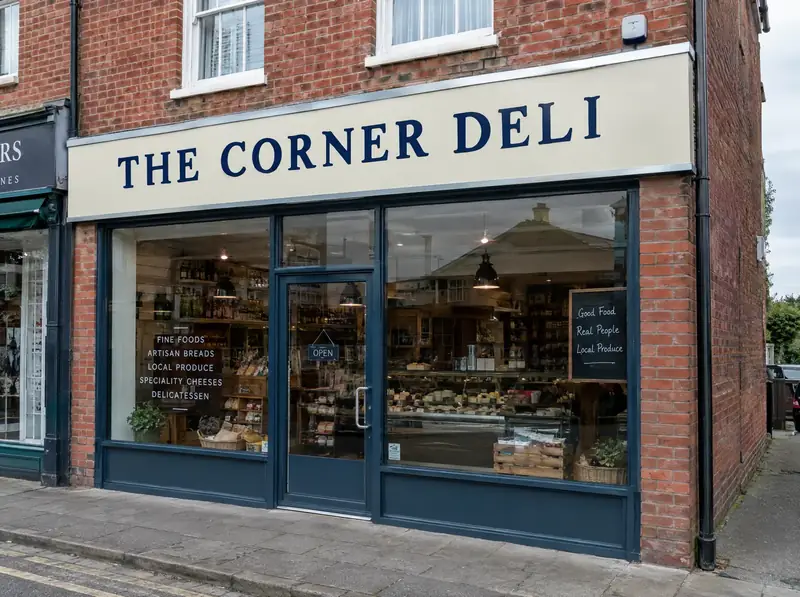
A fascia sign is the flat panel fixed along the board above a shop or office frontage, usually 3–4 mm aluminium composite carrying printed or cut-vinyl lettering, a logo and sometimes contact details.
Many high-street businesses start with a flat fascia because it does the most work for the money: one panel, your name at a readable size, and a clean line across the shopfront. We survey the frontage, draw the sign to scale on a photo of your building, and fit it with stainless fixings once you approve the proof. Nothing is made until then.
This guide covers what the panel is made of, how a new sign goes over an old fascia board, how we match brand colours, and what makes lettering readable from across the road. If you want more depth or a premium edge, compare tray signs and built-up letters; if you trade after dark, look at sign lighting or illuminated letters too.
What is a fascia sign made from?
The standard panel is aluminium composite: two thin aluminium skins bonded to a polyethylene or mineral core, 3–4 mm thick in total. It stays flat over long spans, doesn't rot or rust, and takes printed vinyl or cut lettering cleanly.
Where a landlord or building control asks for a mineral core, we specify it at quote stage. Panel edges can be left plain, capped with a matching trim, or swapped for a folded tray if you want visible depth.
- Panel: 3 mm or 4 mm aluminium composite, chosen for span and exposure
- Graphics: cut cast or calendered vinyl, or a full-colour laminated print
- Trims: aluminium edge trim in a matching or contrasting colour
- Fixings: stainless steel, hidden under trim or with colour-matched heads
Can a new sign go over my existing fascia board?
Usually, yes. If the old timber or render fascia is sound and reasonably flat, the new panel is fixed straight over it, often on a timber or aluminium subframe that packs out bows and keeps the face true. That is quicker and tidier than stripping everything back.
If the board is rotten, loose or badly out of line, we tell you at survey and price the making good: replacing sections of timber, sealing the top edge against water, or fitting a full subframe. Old box signs, brackets and redundant cables come down first, with any old lighting circuit isolated, and the fixing holes are filled so the new panel sits on a sound surface. Making good is itemised on the quote, so you can see what it adds.
How do you measure a fascia for a sign?
Measure the full width between the pilasters or corbels, then the height of the flat area you want covered, at both ends and in the middle; older frontages are rarely square. Note anything that breaks the line, such as a shutter box, alarm bell, camera or downpipe.
Rough sizes and photos are enough for a guide price. Before anything is made we survey properly with a laser measure and draw the panel to scale on an image of your frontage, so you can judge the proportions before you approve.
- Width between pilasters, top and bottom
- Height at the left, middle and right
- Height of the fascia above the pavement
- Position of shutter boxes, lights and cameras
- Any canopy, gutter or overhang above the board
Can you match my brand colours exactly?
We match to the reference you give us: a RAL or Pantone number, a brand guide or a physical sample. Printed panels are colour-managed to the nearest achievable match, and cut-vinyl lettering is chosen from the solid colours that sit closest to your reference.
Colours on screen and in print rarely look identical, so for strong brand colours we can send a printed swatch before production. Daylight, the direction of the sun and a gloss or matt finish all shift how a colour reads outdoors, which is why we check against a physical sample rather than a monitor.
- RAL: common for panels, trims and powder coat
- Pantone: common for logos and printed graphics
- Physical sample: a reliable reference for a print match
What makes a fascia sign easy to read?
Contrast and letter size do most of the work. Dark letters on a light panel, or the reverse, read from much further away than two mid-tones side by side, and a plain typeface holds up at distance far better than a fine script.
Size the lettering for where people actually stand: across the road, at a bus stop or walking along the pavement. In England, keeping letters no taller than 0.75 m is also one of the conditions for deemed advertisement consent on a non-lit sign.
- Strong light and dark contrast between letters and panel
- A clear typeface with open letter shapes
- Margins of empty panel around the text
- Lettering sized for the main viewing distance
- Phone number and web address kept secondary
Options and finishes
Printed panel
Full-colour laminated print on aluminium composite, for logos, photos and gradients.
Cut-vinyl lettering
Solid-colour vinyl letters on a coloured panel, easy to update later.
Panel with edge trim
An aluminium trim frames the panel and hides the fixings.
Re-skin of an old sign
A new face fixed over a sound existing sign frame.
Panel with trough lighting
A flat panel lit by LED trough lights or spotlights after dark.
Mineral-core panel
Specified where a landlord or building control asks for one.
How much do fascia signs cost?
Guide prices, supplied and fitted and excluding VAT, are £495 to £950 for an aluminium composite fascia up to 3 m and £750 to £1,650 for 3–5 m. Full-colour prints and colour-matched trims sit toward the top of each range.
Removing and disposing of an old sign is guided at £95 to £250, and a scaffold tower or access platform, if needed, at £150 to £450 per day, both excluding VAT. Repairs to the board are priced only if the survey shows they are needed, and every figure is confirmed after survey and an artwork check.
| Item | Guide, ex VAT | Inc. VAT (20%) |
|---|---|---|
| Aluminium composite fascia, up to 3 m | £495 – £950 | £594 – £1,140 |
| Aluminium composite fascia, 3–5 m | £750 – £1,650 | £900 – £1,980 |
| Remove and dispose of an old sign | £95 – £250 | £114 – £300 |
| Scaffold tower or access platform, per day (if needed) | £150 – £450 | £180 – £540 |
Guide prices exclude VAT and are confirmed after survey or artwork check. Basis: flat panel fascia up to about 5 m long, printed or vinyl-lettered, supplied and fitted.
Permission and rules
In England, a non-illuminated fascia sign on your own business premises usually has deemed consent under the Town and Country Planning (Control of Advertisements) (England) Regulations 2007 if the lettering is no taller than 0.75 m (0.3 m in an area of special control) and the top of the sign is no higher than the bottom of any first-floor window. A sign on a listed building usually also needs listed building consent. Wales, Scotland and Northern Ireland have their own advertisement regulations with different detail, so we check with the council before you commit and can prepare the drawings and photos for an application, or submit it for you.
Specification at a glance
| Typical size | Up to about 5 m long; height set by the existing fascia board |
|---|---|
| Materials | 3–4 mm aluminium composite with cut vinyl or a laminated print |
| Typical lifespan | Panel lasts many years; vinyl faces typically need renewing first |
| Typical lead time | typically made and fitted 2–3 weeks after you approve the proof |
| Fixing / installation | Stainless fixings over the existing fascia, on a subframe where needed |
| Consent | Non-lit signs often have deemed consent in England; listed buildings usually need more |
Before you ask for a quote
- Measure the fascia width between pilasters and its height at both ends.
- Photograph the whole frontage straight on, plus close-ups of the existing board.
- Find your logo files and any RAL or Pantone brand colours.
- Check your lease or landlord rules on signage size, colour and approval.
- Note whether the building is listed or in a conservation area.