
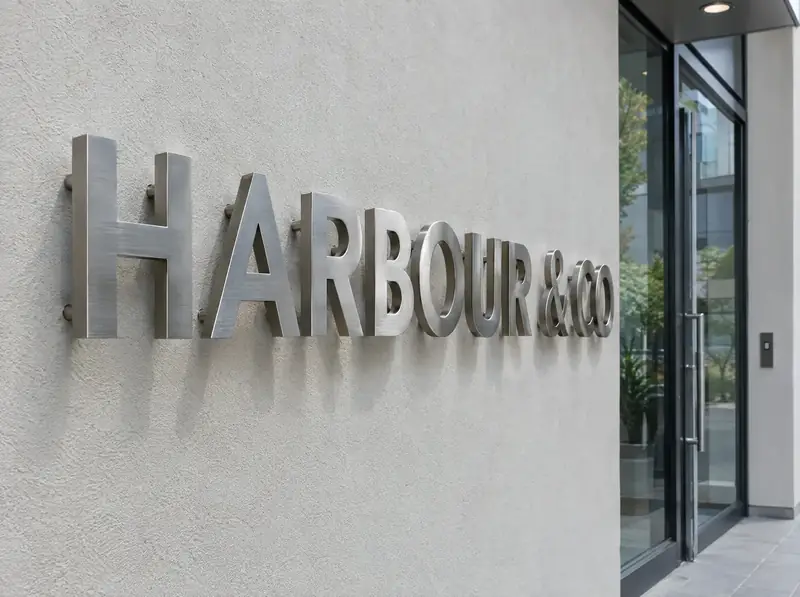
Built-up letters are three-dimensional letters fabricated, usually from metal sheet, with a face and returns joined into a hollow letter typically 50–100 mm deep, then fixed to a wall or sign on locators.
Fabricated letters turn a name into an object. Each letter is cut, folded and welded or bonded from sheet metal, so it has a face, sides and real depth, and it throws a shadow that shifts through the day. Fixed straight to brick, render or a cladding panel, they need no background sign at all, which suits buildings with architecture worth showing.
This page covers non-illuminated letters: metal choices, return depth, how letters are fixed using a paper template, sensible letter heights and which fonts fabricate cleanly. Face-lit and halo-lit letters use the same construction and have their own pages. Decide before fabrication starts, because a non-lit letter can't easily be converted to light afterwards. If you trade after dark, compare them before you choose.
Which metal should my letters be made from?
Stainless steel grade 304 suits most locations, while grade 316 has better corrosion resistance and is the one to specify for coastal and marine settings. Both come brushed, mirror polished or painted.
Painted aluminium is lighter and takes any RAL colour, which makes it the usual choice for brand-coloured letters. For a warm, high-end finish, brass and copper effects are available; solid brass and copper darken as they weather unless lacquered, so we confirm whether you want that patina or a sealed finish. Seeing a sample of each finish in daylight helps you choose.
- 304 stainless: brushed or mirror, general use
- 316 stainless: coastal and marine settings
- Painted aluminium: any RAL colour, lighter weight
- Brass or copper finish: warm tone for premium frontages
How deep should the letter returns be?
Returns, the sides of each letter, are commonly 50–100 mm deep. Deeper returns look more solid from an angle and suit large letters seen from a distance, while shallower returns keep smaller letters neat and in proportion.
As a working guide, the return should look proportionate to the letter: a 300 mm letter on a 50 mm return looks crisp, while much larger letters usually want more. Very deep returns on small letters can look heavy, so the proof shows them to scale. Returns can match the face or contrast with it, such as black sides with brushed faces, which sharpens the outline from the side.
- 50 mm: neat on smaller letters
- 75 mm: a common all-round depth
- 100 mm: bold presence on large letters
How are built-up letters fixed to the wall?
Each letter has threaded studs or locators fixed to its back. We prepare a full-size paper template marked with every letter outline and fixing point; it is taped to the wall, levelled, and the holes are drilled through it so the spacing matches the approved drawing.
Studs go into resin-anchored holes in masonry, or into fixings that suit cladding. Stand-off locators hold letters off the wall for a floating shadow, while flush fixing sets them tight to the surface. On brick, drilling into mortar joints rather than brick faces is easier to make good later and is usually preferred on older buildings.
- Full-size paper template for exact spacing
- Resin anchors into brick, block or stone
- Stand-offs or flush fixing, to suit the look
How tall should my letters be?
Letter height depends on viewing distance, the space available and the length of the name. Our guide prices are based on letters around 300 mm tall, which suit a single-storey shopfront read from across the street; buildings seen from a car park or road usually need taller letters.
Width matters as much as height, because a long name at a large size may not fit. We draw the letters to scale on a photo of the building and adjust height, spacing and line breaks before anything is cut. In England, letters no taller than 0.75 m is one condition of deemed consent for non-lit signs on business premises.
- Measure the wall or fascia space available
- Count the letters, including any ampersand
- Decide whether a second line or logo is needed
Which fonts and logos work as built-up letters?
Bold typefaces with a reasonably even stroke fabricate cleanly. Very thin strokes, hairline serifs and fine script joins are hard to fold, weld and fix, and can look fragile from the street, so we may thicken strokes slightly or suggest a heavier weight of the same font.
Logos work well when they are made from solid shapes. Fine detail, gradients or small text inside a logo don't translate into metal, so the usual answer is to fabricate the main shape to the same depth as the letters and apply the detail to its face in vinyl or print.
- Good: geometric sans-serifs, slab serifs, bold weights
- Harder: hairline serifs, thin scripts, tiny counters
- Logos: solid shapes fabricated, fine detail applied on the face
Options and finishes
Brushed 304 stainless
Satin-grain stainless for most inland locations, classic and understated.
316 stainless
Higher-grade stainless for coastal sites where salt air attacks lesser grades.
Mirror-polished stainless
Reflective faces that catch light, but show fingerprints.
Painted aluminium
Lightweight letters painted or powder coated to any RAL colour.
Brass or copper finish
Warm metallic faces, lacquered or left to patina.
Contrast returns
Faces in one finish and sides in another, such as brushed with black.
How much do built-up 3D letters cost?
Non-illuminated letters around 300 mm tall are guided at £55 to £165 per letter, supplied and fitted, excluding VAT. A typical business name of 10–14 letters is guided at £850 to £2,600, and a logo or symbol made to the same depth adds a guide £150 to £650.
The metal drives cost first: painted aluminium sits at the lower end, mirror stainless and brass finishes at the top. Letter height, return depth, letter count, stand-off locators, access height and the wall surface follow. Every price is confirmed after survey and an artwork check.
| Item | Guide, ex VAT | Inc. VAT (20%) |
|---|---|---|
| Fabricated letter, 300 mm tall | £55 – £165 | £66 – £198 |
| Typical business name (10–14 letters) | £850 – £2,600 | £1,020 – £3,120 |
| Logo or symbol, made to the same depth | £150 – £650 | £180 – £780 |
Guide prices exclude VAT and are confirmed after survey or artwork check. Basis: non-illuminated fabricated letters around 300 mm tall, stainless steel or painted aluminium, fitted on locators.
Permission and rules
Non-illuminated built-up letters on your own business premises in England usually have deemed consent under the 2007 Advertisement Regulations, provided no letter or symbol is taller than 0.75 m (0.3 m in an area of special control) and the top of the lettering is no higher than the bottom of any first-floor window. Letters on an upper storey or parapet fall outside those conditions and usually need express consent; decisions usually take up to 8 weeks. A listed building usually needs listed building consent too. Wales, Scotland and Northern Ireland differ in detail, so we check with the council and can prepare drawings for an application, or submit it for you.
Specification at a glance
| Typical size | Letters around 300 mm tall on shopfronts; taller on larger buildings |
|---|---|
| Materials | 304 or 316 stainless steel, painted aluminium, brass or copper finishes |
| Typical lifespan | Many years outdoors; painted finishes may eventually need recoating |
| Typical lead time | typically 3–5 weeks after proof approval, depending on metal and finish |
| Fixing / installation | Studs or locators into resin anchors, set out with a full-size paper template |
| Consent | Non-lit letters often deemed in England within limits; upper-storey letters usually need express consent |
Before you ask for a quote
- Measure the wall or fascia space available for the lettering, width and height.
- Photograph the wall surface close up so we can judge brick, render or cladding.
- Send your logo and font name, ideally as vector artwork.
- Choose a metal and finish, or describe the look you want.
- Note whether the site is near the coast, which affects the stainless grade.