
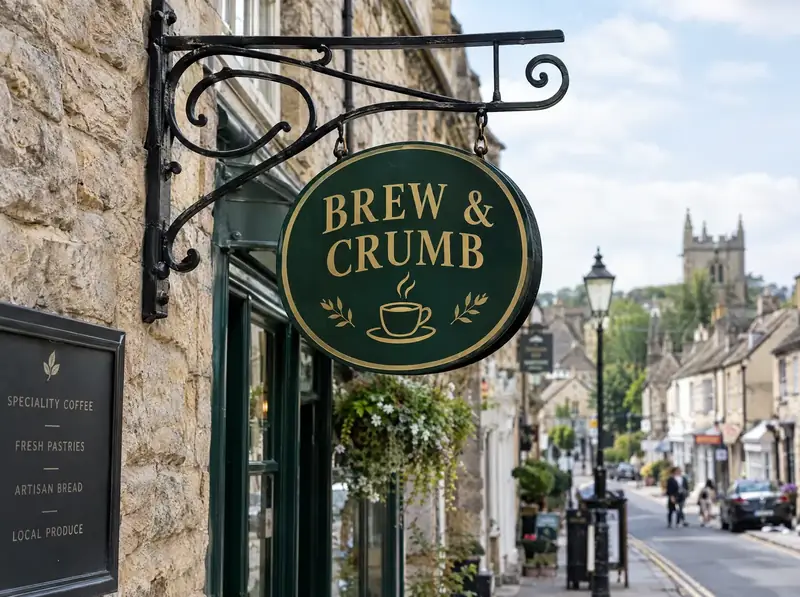
A projecting sign is a sign, usually double-sided, fixed at right angles to a building on a wall bracket, so it can be read by people approaching along the street from either direction.
Walk down any market-town street and you read the hanging signs before the fascias. A fascia faces the road; a projecting sign faces the pavement, so it catches people who are already walking towards you. That makes it a very effective addition to a frontage, especially where buildings are close together and fascias are hard to see at an angle.
Projecting signs also come with more rules than most signs, because they hang over the public footway. Clearance above the pavement, how far the sign sticks out and who controls the space beneath it all matter. We cover sign and bracket styles, those clearances, materials that suit conservation areas, and the consents you may need. Getting them right at drawing stage avoids costly changes later.
What styles of projecting sign are there?
The classic is a flat double-sided board hung from a bracket, in a rectangle, oval, circle or shield shape. Modern versions use aluminium composite or a slim aluminium tray with printed or vinyl graphics on both faces; traditional ones use painted timber, or aluminium made to look like it, with painted-style lettering and moulded edges.
Shaped signs cut to a symbol, such as a coffee cup, key or pair of scissors, read instantly from a distance. A sign can also be fixed rigidly to the bracket arm rather than hung, which stops it swinging in wind and suits contemporary frontages.
- Hanging board: swings from hooks or chains
- Fixed blade: rigid, mounted directly to the arm
- Shaped sign: cut to a symbol or outline
What kind of bracket do I need?
The bracket has to suit both the sign and the building. Traditional wrought-iron-style brackets, with scrolls and finials, suit period frontages and pubs; modern brackets are plain flat bar, tube or a box arm in a powder-coated finish.
Size and strength are matched to the sign's area and weight, because wind load on a hanging sign is significant. We fix into sound masonry with resin anchors and stainless fixings, and on historic buildings into mortar joints where possible. Bracket and sign are designed together, so projection and clearance are settled before anything is made or drilled.
- Traditional scroll bracket in black or a heritage colour
- Modern flat-bar or tube bracket, powder coated
- Wall plate sized to spread the load into the masonry
How high above the pavement must a projecting sign be?
Councils usually expect a clear height of at least about 2.1 m above the pavement, and often more; check the local requirement. The clear height is measured from the footway surface to the lowest point of the sign or bracket, so a hanging sign's chains and bottom edge both count. Near loading areas, or where vehicles can mount the kerb, a higher clearance is often asked for.
Projection is limited too. The sign should stay well back from the kerb edge, clear of high-sided vehicles, and the highway authority may set a maximum projection. We measure the pavement width, the kerb line and nearby features such as lamp posts at survey, and draw the sign in position. Changes are far cheaper on paper.
Which materials suit a conservation area?
Painted timber is the traditional choice and is often preferred in conservation-area design guidance: a moulded board with a painted or gilded-effect finish on a black bracket. Aluminium can be made to look very similar, with routed edges and painted finishes, and it won't rot, split or need repainting as often.
Keep colours muted, lettering simple and illumination out unless the council supports it, because in conservation areas deemed consent for illuminated signs does not apply. Check whether the building is listed, since the bracket fixing then usually needs listed building consent.
- Painted timber with a moulded edge
- Painted aluminium that looks like timber
- Gold-effect or painted lettering
- Lettering in a traditional serif or hand-painted style
- Dark bracket with simple scrolls
Does a projecting sign need regular checks?
Yes. Anything hanging over a public footway needs to stay secure, so check the bracket, fixings, hooks or chains and the sign itself at least once a year and after strong winds. Look for loose fixings, rust staining, cracked mortar around the wall plate and wear where hooks rub.
Timber signs need repainting as the finish weathers, while aluminium needs only cleaning. If a sign is damaged, take it down until it can be repaired, and keep a note of each check. We can quote to refurbish a sound existing bracket and replace a worn sign on it.
- Wall plate and fixings: tight, no cracking
- Bracket arm: no rust bleeding or bending
- Hooks and chains: no heavy wear or rust
- Sign: secure, no splits or delamination
Options and finishes
Double-sided panel sign
Print or vinyl on both faces of a composite or tray sign, on a standard bracket.
Painted timber-style sign
Moulded board in timber or timber-effect aluminium for period frontages.
Shaped symbol sign
Cut to a cup, key or scissors outline, so it reads before the words do.
Traditional scroll bracket
Wrought-iron-style bracket with scrolls, in black or a heritage colour.
Modern blade sign
A rigid sign on a flat-bar or tube arm that doesn't swing.
Oval or round hanging sign
Classic shapes on hooks or chains for cafés, pubs and bakeries.
How much do projecting and hanging signs cost?
A double-sided panel sign with a standard bracket is guided at £395 to £850, supplied and fitted and excluding VAT. Shaped or painted signs with a decorative bracket are guided at £650 to £1,350. Both are confirmed after survey and an artwork check.
Size and shape come first, then the bracket: a scroll bracket costs more than flat bar, and larger signs need stronger brackets and wall plates. Painted finishes, access height, the wall type and any drawings for a highway licence or advertisement consent also affect the figure.
| Item | Guide, ex VAT | Inc. VAT (20%) |
|---|---|---|
| Double-sided panel sign with standard bracket | £395 – £850 | £474 – £1,020 |
| Shaped or painted sign with decorative bracket | £650 – £1,350 | £780 – £1,620 |
Guide prices exclude VAT and are confirmed after survey or artwork check. Basis: double-sided non-illuminated projecting sign up to about 800 mm, with wall bracket.
Permission and rules
In England, a non-illuminated projecting sign on your own business premises can have deemed consent under the 2007 Advertisement Regulations, within limits that include letters no taller than 0.75 m (0.3 m in an area of special control) and the top of the sign no higher than the bottom of any first-floor window. Most illuminated projecting signs need express consent, and in conservation areas deemed consent for illumination does not apply. Because the sign overhangs the footway, a separate licence from the highway authority may also be needed. Listed buildings usually need listed building consent too. Wales, Scotland and Northern Ireland differ in detail, so we check with the council first.
Specification at a glance
| Typical size | Up to about 800 mm across, double-sided |
|---|---|
| Materials | Aluminium composite, aluminium tray or painted timber; steel bracket |
| Typical lifespan | Aluminium lasts many years; painted timber needs periodic repainting |
| Typical lead time | typically 2–4 weeks after proof approval, plus any consent or licence time |
| Fixing / installation | Steel bracket on a wall plate, resin-anchored with stainless fixings |
| Consent | Check advertisement consent and any highway licence; lit versions usually need express consent |
Before you ask for a quote
- Measure the pavement width from your wall to the kerb edge.
- Photograph the wall where the bracket would go, including any first-floor windows.
- Note the fascia height and any canopy, shutter box or street lamp nearby.
- Choose a traditional or modern style, and a shape for the sign.
- Check whether the building is listed or in a conservation area.