
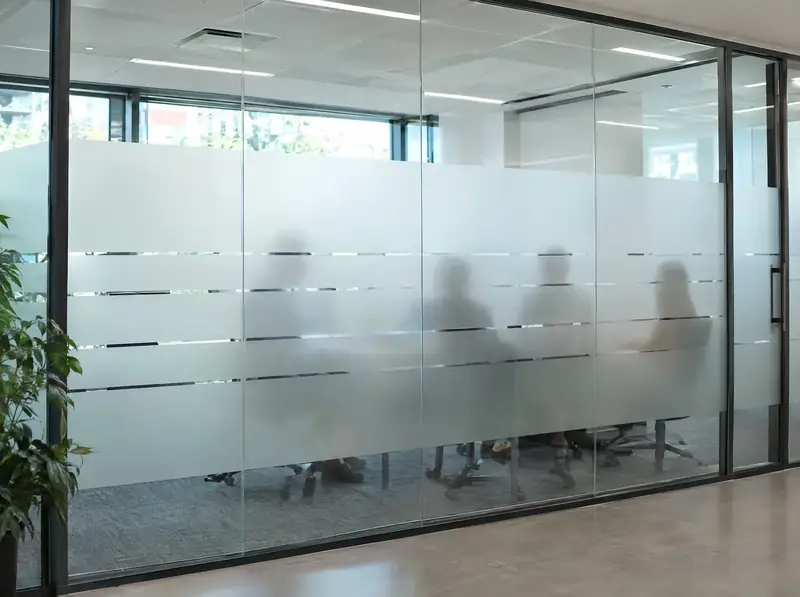
Frosted window film is a translucent, etch-effect self-adhesive film that blurs the view through glass while still letting daylight pass, giving the look of sandblasted glass without replacing it.
Glass makes rooms feel open, but not every room should be on show. Frosted film gives privacy to meeting rooms, consulting rooms, washrooms and street-facing desks while keeping the daylight that made you want glass in the first place. Fitted well, it is hard to tell from etched glass and, unlike etching, it peels off when the layout or tenant changes.
Plain film is only the starting point. Bands at eye level, gradients that fade from opaque to clear, and patterns or logos cut out of the film let you decide exactly how much people can see. We set out the heights room by room, measure every pane and send a scaled drawing so you can judge the effect before anything is fitted.
How much privacy does frosted film give?
Frosted film blurs rather than blocks. From a metre or two away, people on the other side become soft outlines: you can tell someone is there, but you usually can't read a screen or make out a face.
Lighting changes the effect. After dark, with lights on inside, silhouettes close to the glass show more clearly from outside, so rooms used in the evening may also need blinds. Height matters as much as density.
- Seated privacy, such as meeting rooms: a band from roughly 800 mm to 1800 mm
- Standing privacy, such as consulting rooms: full height, or up to about 2000 mm
- Street-facing desks: the lower half or two-thirds, clear above for daylight
- Washrooms: full panes in a denser white film
Does frosted film make a room darker?
Less than most people expect. Frosted film is translucent, so daylight still comes through, softened and spread more evenly; the bigger change is usually less glare. It is not a solar control film, though, so it does little to cut heat.
How much light passes depends on density, which manufacturers state as visible light transmission on the data sheet. Light etch films keep a room bright; denser white films give more privacy but block more light.
If a room relies on one window, frost only the band that needs privacy and leave the top clear. Cut-out stripes let light and glimpses through, which stops a long run of glazed partitions feeling like a solid wall. We can supply a sample to hold against the glass.
What designs can be cut into frosted film?
Almost anything that works as a clean outline. The film is cut to vector shapes by a plotter and the waste is lifted, leaving clear glass in the shape of your design, or frosted shapes on clear glass. Very thin lines and tiny text can lift at the edges, so we thicken them where needed and show the result on the proof.
- Plain: one sheet edge to edge for full privacy
- Banded: one or more horizontal strips at set heights
- Gradients and dot fades: solid frost fading to clear glass
- Stripes: clear lines cut through a frosted panel
- Logos and names: cut clear from the frost, or frosted onto clear glass
- Repeating patterns: geometric or brand-led motifs along a partition run
Where should you avoid frosting glass?
Frosting the wrong pane can create a safety problem, so before fitting we walk through the layout with you and leave clear the glass people need to see through.
Frosted bands at the right heights can also act as glass manifestation, which has its own page. Film is easy to remove, but it is simpler to get the layout right first time.
- Vision panels in doors, which show someone coming the other way
- Glass that fire exit signs, alarm call points or fire equipment are seen through
- Fire-resisting glazing, unless the door or glass supplier confirms film is acceptable
- Sightlines that reception staff, lone workers or CCTV cameras rely on
- Glass that lets staff see into rooms where children or vulnerable people are cared for
Can frosted film be removed later?
Yes. Frosted film is held by a pressure-sensitive adhesive and comes off with gentle heat and a plastic blade, leaving glass that cleans back to clear. That suits tenants who must return a space to its original state at the end of a lease, and businesses that reorganise often.
When a meeting room becomes open-plan, the film comes off; when a new team moves in, a new logo can go on. If the film on one pane is damaged, it can be re-cut to match. Film that has been up for many years can turn brittle and slower to remove, which is reflected in the price.
Day to day, clean it with a soft cloth and mild soapy water, keeping scourers and blades off the film.
Options and finishes
Plain etch-effect
Full-pane frosting like sandblasted glass.
Privacy bands
Frosted strips at set heights.
Gradients and dot fades
Solid frost fading to clear glass.
Logo cut-outs
Your name or logo cut clear from the frost.
Coloured frost
Tinted translucent film to suit an interior.
How much does frosted window film cost?
Guide prices are £32–£48 per m² for plain frosted film and £45–£68 per m² with a cut-out design, supplied and fitted, excluding VAT. Small jobs carry a £225 + VAT minimum.
Pane count, design detail, high glazing needing a tower, and old film to remove all move the figure; the price is confirmed after survey and design approval.
| Item | Guide, ex VAT | Inc. VAT (20%) |
|---|---|---|
| Plain frosted film, per m² | £32 – £48 | £38.40 – £57.60 |
| Frosted film with cut-out design, per m² | £45 – £68 | £54 – £81.60 |
| Minimum job | £225 | £270 |
Guide prices exclude VAT and are confirmed after survey or artwork check. Basis: etch-effect frosted film, plain, banded or with cut-out designs, fitted. Minimum job £225 + VAT.
Permission and rules
Plain frosting on internal glass is a privacy finish, not an advertisement, so planning rules rarely apply. Frosting on a street-facing window that carries your name or logo can count as an advertisement, and councils treat window graphics differently; England, Wales, Scotland and Northern Ireland each have their own advertisement regulations. On a listed building, changing the look of historic windows can need listed building consent. Indoors, check your lease, as many landlords want to approve anything fixed to glazing, and keep vision panels and exit signs visible. We check these points with you first.
Specification at a glance
| Typical size | Single panes to full partition runs |
|---|---|
| Materials | Etch-effect frosted film; opal, tinted and gradient films |
| Typical lifespan | Typically several years outdoors by manufacturer ratings; longer indoors |
| Typical lead time | typically fitted 1–2 weeks after layout approval |
| Fixing / installation | Usually wet-applied to the room side of the glass |
| Consent | Rarely needed indoors; street-facing logos and listed buildings checked |
Before you ask for a quote
- Measure each pane and count the doors and side panels.
- Mark which rooms need seated, standing or full privacy.
- Photograph the glazing from both sides, including vision panels.
- Check whether any glass is fire-resisting.
- Choose plain, banded, gradient or logo designs.