
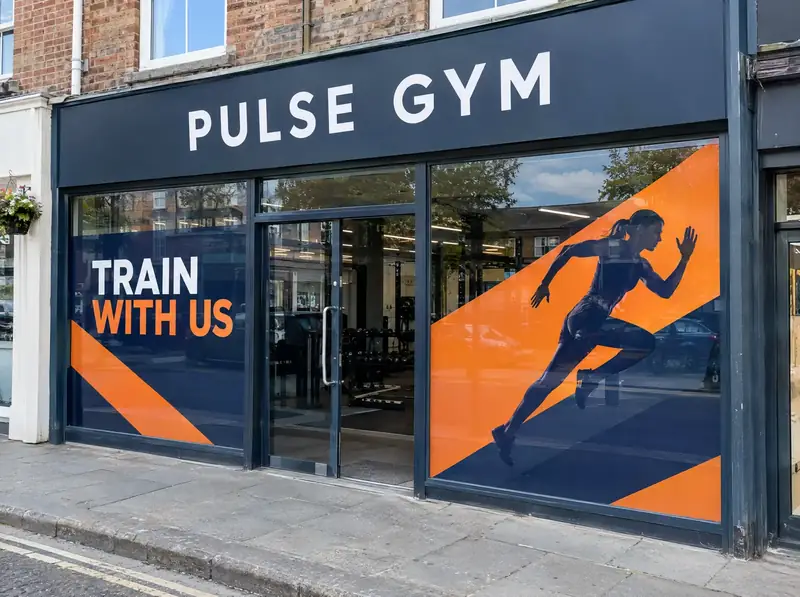
Window graphics are full-colour images or branding printed on self-adhesive vinyl and applied to glass, outside or reverse-printed for the inside, so the window works as a sign.
Your shop window is the biggest surface you have facing the street, and printed vinyl lets you use all of it. We print your artwork, laminate it where needed and fit it so it reads cleanly from the pavement. A graphic can cover a whole frontage, run as a band at eye level, or frame a display people still need to see.
The right graphic depends on what the window has to do. A gym wants energy and a clear offer; a clinic wants privacy without darkness; a café wants passers-by to still see people inside. Below we cover inside versus outside fitting, coverage and light loss, changeable promotions, the artwork we need, what drives the price and how to look after it.
Should graphics go inside or outside the glass?
Inside is usually the better home for a shop window graphic: it is out of the rain, harder to pick at and easier to clean around. To read correctly from the street it is reverse-printed as a mirror image on clear film, often with a white layer behind the ink so the back looks tidy from the shop floor.
Outside application suits glass you can't reach from inside, such as panes behind fixed displays or windows with a reflective coating that would dull an inside print. Graphics on the outside face are laminated against UV, rain and scratches.
One caution: a dark film across a large, sunny pane can add thermal stress to some types of glass, so we check the glazing before quoting.
How much of the window should you cover?
Cover only as much glass as the room behind can spare. Full coverage gives the strongest effect from across the road, but it costs daylight and the view in, and passers-by can't tell whether you're open. Many businesses get more from partial coverage that frames the display.
Standard printed vinyl is solid, so a full-coverage graphic blocks most daylight. If the space behind needs light, one-way vision film or a frosted panel with printed elements keeps it brighter.
- Full coverage: maximum street presence, but no view in and little daylight
- Eye-level band: carries the name and offer while the glass above and below stays clear
- Lower panel: hides stock or desks and lets light in at the top
- Border or frame: draws the eye to a window display behind the glass
Can graphics change with each promotion?
Yes, if the window is planned for it. Split the glass into a permanent layer and a changing one: your name and logo stay put, while a promotion panel of fixed size is swapped for each sale, season or launch. Because the panel size never changes, new artwork drops into the same template and is reprinted without measuring again.
Removable-adhesive films are made to peel off cleanly within their rated life, and static cling film, which has no adhesive at all, suits small, short-lived messages inside the glass. Old graphics come off with gentle heat and a plastic scraper, and leftover adhesive is cleaned off before the next set goes on.
Tell us how often offers change and we'll suggest a panel size.
What artwork do you need to supply?
We need vector logos, high-resolution images and accurate glass sizes, because large-format print is less forgiving than a screen. A photo that looks crisp on a phone can break up into blocks across a 3 m window, so every file is checked at full size. No print-ready artwork? We can design it from your logo and wording and send a proof drawn to scale on a photo of your window. Nothing is printed until you approve the proof.
- Logos and text: vector files (PDF, EPS or SVG) so edges stay sharp at any size
- Photographs: around 100–150 dpi at the finished printed size
- Brand colours: the references from your brand guidelines
- Fonts: converted to outlines or supplied with the files
- Measurements: the visible glass of every pane, inside the frame
How do you clean window graphics?
Wash them as you would the glass: a soft cloth or sponge, mild soapy water, then a squeegee worked from the middle of the graphic out towards the edges. Brief your window cleaner too, because a blade pushed against an edge is the quickest way to lift it.
Laminated window vinyl is typically rated by its manufacturer for several years outdoors, and a print on the inside face generally outlasts the same print outside. Direct sun fades colours fastest, so south-facing windows age sooner.
- No abrasive pads, solvents or strong alcohol cleaners on the printed face
- Keep pressure-washer jets well away from the edges
- Don't tape posters or notices over the graphic
- A lifting corner caught early can often be pressed back down
Options and finishes
Reverse-printed inside
Mirror-printed film fitted behind the glass.
Outside laminated
Laminated print for glass you can't reach inside.
Double-sided print
Finished from the street and the shop floor.
Promotion panels
Fixed-size removable panels, reprinted per campaign.
Static cling
Adhesive-free film for short-term messages inside.
How much do window graphics cost?
Printed window vinyl is guided at £28–£58 per m², supplied and fitted, excluding VAT, with a £225 + VAT minimum. Reverse printing, double-sided images and outside lamination cost more.
Many small panes take longer than one large one. Access, design time and old graphics removal (guide £6–£15 per m² + VAT) also count; the price is confirmed after survey and artwork check.
| Item | Guide, ex VAT | Inc. VAT (20%) |
|---|---|---|
| Printed window vinyl, per m² | £28 – £58 | £33.60 – £69.60 |
| Minimum job | £225 | £270 |
| Removal of old graphics, per m² | £6 – £15 | £7.20 – £18 |
Guide prices exclude VAT and are confirmed after survey or artwork check. Basis: full-colour printed and laminated window vinyl, fitted. Minimum job £225 + VAT.
Permission and rules
Councils treat window graphics differently, so there is no single answer. In England the 2007 advertisement regulations apply, and in conservation areas and on listed shopfronts large window graphics can be restricted; listed buildings may also need listed building consent. Wales, Scotland and Northern Ireland have their own regulations, and details differ. Leases and shopping centre rules often control glazing too. We check the position for your premises before anything is printed and, if consent is needed, we can prepare the drawings and photos for an application or submit it for you.
Specification at a glance
| Typical size | One door panel to a full frontage |
|---|---|
| Materials | Printed window vinyl, clear or white, laminated outside |
| Typical lifespan | Typically several years outdoors by manufacturer ratings; longer inside |
| Typical lead time | typically fitted 1–2 weeks after proof approval |
| Fixing / installation | Applied to cleaned glass, trimmed to the frame |
| Consent | Varies by council; conservation areas and listed shopfronts checked |
Before you ask for a quote
- Measure each pane's visible glass, inside the frame.
- Photograph the frontage straight on, and from inside.
- Decide whether you need a view in or out.
- Gather logo files, brand colours and the wording.
- Check your lease and conservation area status.