
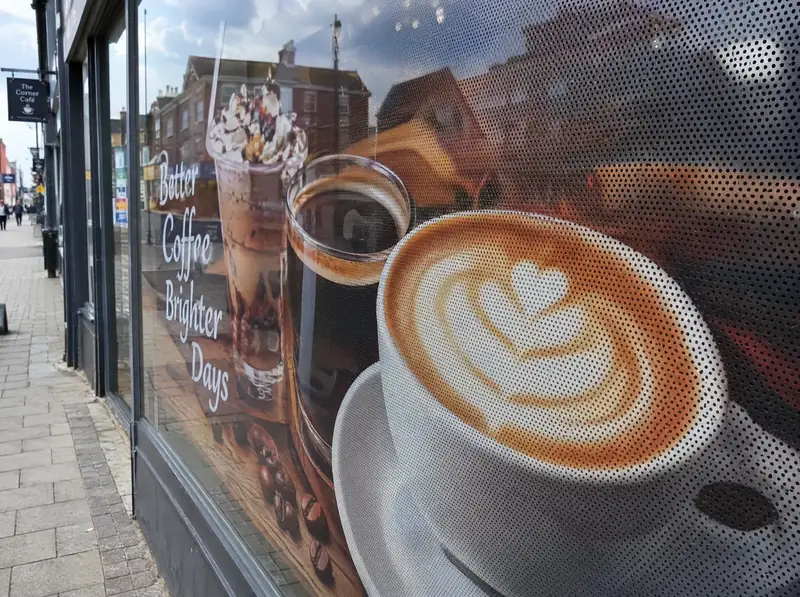
One-way vision film is perforated self-adhesive vinyl, printed on its outer face and black behind, that shows a full-colour image to people outside while letting those inside see out through the holes.
One-way vision solves a problem every business with big windows has: you want the glass to advertise, but you don't want to sit in the dark or lose sight of the street. Perforated printed film does both, which is why it appears on café fronts, salon windows, takeaway counters, high-street offices and the rear windows of vans and some cars.
Like any window film, it also has quirks. The effect depends on light, fine print loses detail across the holes, and the film has a shorter life than solid vinyl, so it suits designs you'll refresh. Here we explain how it works, the 50/50 versus 70/30 choice, artwork that suits it, the rules for vehicle windows, and how long it lasts.
How does one-way vision film work?
The film is white printable vinyl with a black adhesive side, punched with thousands of small holes across its whole area. Outside, the printed face reflects daylight to passers-by, whose eyes read the dots as a complete picture. Inside, the black backing reflects very little, so you look through the holes to the brighter street.
It works when it's brighter outside than inside. On a bright afternoon the image is bold from the pavement and the view out is clear. After dark, with lights on inside, the effect reverses: people outside can see in and the image looks faded, so evening traders often add blinds.
From inside, the street looks slightly dimmed, a little like looking through a fine fly screen.
What is the difference between 50/50 and 70/30?
The numbers give the split between printed film and holes. 50/50 film is half print, half holes; 70/30 has 70 parts print to 30 parts holes. More print gives a brighter, more solid image outside but a darker view from inside; less print keeps the view clearer but the image paler close up.
Hold a sample against your own window before choosing: the difference is easiest to judge in your light, at the distance people will see it from.
- 50/50: the usual choice for vehicle rear windows and where the view out matters most
- 70/30: a stronger image for shop and office windows
- Optically clear laminate: protects the print and stops rain sitting in the holes
- Unlaminated film: short campaigns only, as dirt collects in the perforations
How should you design artwork for one-way vision?
Design for distance. The holes remove part of every letter and line, so fine text, thin outlines and small details break up; a phone number that is crisp on screen can be hard to read on the window. Large areas of colour and simple shapes come out strongest.
Before printing, you see a scaled mock-up of the design on a photo of your own window, so you can judge legibility.
- Keep text large and bold, without thin serifs or hairlines
- Use strong, saturated colours; pale tints wash out over the holes
- Put small but vital details, such as a phone number, on solid vinyl
- Keep key content clear of frames, glazing bars and door handles
- Prefer photos and bold shapes to paragraphs of text
Can one-way vision go on vehicle windows?
Usually yes, on rear windows. The Road Vehicles (Construction and Use) Regulations 1986 require the windscreen to let through at least 75 per cent of light and the front side windows at least 70 per cent, so we always keep graphics off those. Rear-window one-way vision is used on vans and cars with two exterior mirrors, because the view out through the film is reduced.
Where the rear window has a wiper, the area it sweeps wears faster, so we discuss leaving that strip clear. Leased vehicles may also need the lease company's agreement first.
Graphics on a vehicle normally used as a moving vehicle are outside advertisement control, but a vehicle parked mainly to act as a billboard is not.
How long does one-way vision last?
Not as long as solid window vinyl, because the holes give weather and dirt more edges to work on. Manufacturers typically rate laminated perforated films for around 1–3 years outdoors, depending on the film and how much direct sun the window gets.
Clean it gently with a soft sponge and soapy water, wiping in one direction and rinsing off. Pressure washers and stiff brushes can lift edges and drive water into the holes. When the print fades, the film peels off and the glass is cleaned before a new design goes up.
- Laminated film is easier to clean, as dirt can't settle in the holes
- Wipe from the edges towards the centre, not against them
- Plan a refresh with each campaign or rebrand
Options and finishes
50/50 film
A clearer view out, softer image.
70/30 film
A bolder image, darker view out.
Laminated finish
Seals the holes and protects the print.
Mixed solid and perforated
Solid vinyl carries small text.
Vehicle rear panels
Cut for vehicles with two exterior mirrors.
How much does one-way vision film cost?
Printed one-way vision has a guide price of £32–£62 per m², printed, laminated and fitted, excluding VAT, with a £225 + VAT minimum job.
Area, pane count, perforation, laminate, text inserts, access and design time move the figure. One van rear screen usually falls under the minimum, so combining jobs helps. Prices are confirmed after measuring and an artwork check.
| Item | Guide, ex VAT | Inc. VAT (20%) |
|---|---|---|
| Printed one-way vision, per m² | £32 – £62 | £38.40 – £74.40 |
| Minimum job | £225 | £270 |
Guide prices exclude VAT and are confirmed after survey or artwork check. Basis: perforated printed window film, laminated, fitted. Minimum job £225 + VAT.
Permission and rules
On a shop or office window, one-way vision is treated like any other window graphic, and councils treat those differently; in conservation areas and on listed shopfronts, large window graphics can be restricted. In England the 2007 advertisement regulations apply; Wales, Scotland and Northern Ireland have their own, and listed buildings may also need listed building consent. Graphics on a vehicle normally used as a moving vehicle are outside advertisement control, but a vehicle parked mainly as a billboard is not. Road rules still apply, so windscreens and front side windows stay clear. We check before printing.
Specification at a glance
| Typical size | One van rear window to full shop frontages |
|---|---|
| Materials | Perforated vinyl, 50/50 or 70/30, clear laminate |
| Typical lifespan | Typically rated around 1–3 years outdoors by manufacturers |
| Typical lead time | typically 1–2 weeks from proof approval to fitting |
| Fixing / installation | Applied to the outside face of clean glass |
| Consent | Window graphic rules apply; windscreens and front side windows kept clear |
Before you ask for a quote
- Measure each pane, noting frames or bars.
- Photograph the windows from outside and inside.
- For vehicles, note make, model, year and mirrors.
- Decide whether view out or image matters more.
- Gather high-resolution images and vector logos.