
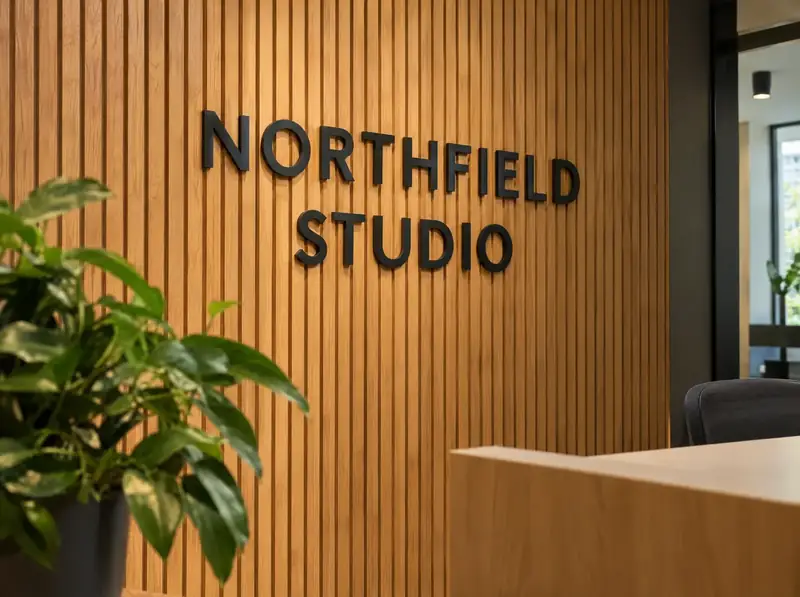
Flat-cut letters are individual letters and logos cut from a single solid sheet, typically 5–10 mm acrylic, aluminium composite or metal, and fixed flush to a wall or held off it on stand-offs.
If you want individual letters without the cost of fabrication, flat-cut is the answer. Each letter is routed or laser-cut from one sheet, so the edges are crisp and the shapes follow your artwork exactly. At 5–10 mm thick they have a slim, precise look that suits reception walls, meeting rooms and smaller exterior fascias, and they cost much less than built-up letters.
Choosing well comes down to four decisions: the material, the thickness, the colour or finish, and whether letters sit flush or float on stand-offs. Indoor and outdoor jobs also differ, because sunlight, rain and temperature swings test materials and fixings in ways a reception never does. We set out each choice below so you can compare options before asking for a quote.
What materials are flat-cut letters made from?
Acrylic is the most common: solid colour all the way through, in gloss or matt, black, white, brand colours, mirror effect and clear. Aluminium composite gives a light, rigid letter with metal skins and a visible core line at the edge, which some designs use deliberately.
Solid metal letters, cut from aluminium, stainless steel or brass-effect sheet, give the weight and edge quality of metal for less than fabrication. For larger letters outdoors, aluminium or stainless is usually more stable than acrylic, which expands and contracts more with heat.
- Acrylic: colours, gloss or matt, clear, mirror effect
- Aluminium composite: light, rigid, cost-effective outdoors
- Solid aluminium or stainless: crisp metal edge, durable
- Vinyl-faced acrylic: exact brand colours on a white or clear letter
Should flat-cut letters be flush-fixed or on stand-offs?
Flush fixing puts letters tight to the wall with studs, adhesive or both, giving a crisp, graphic look that suits smooth plaster, glass and timber slats, and costs slightly less. Stand-off fixing holds each letter 10–25 mm off the surface on small spacers, so it casts a shadow and looks more three-dimensional.
Stand-offs also help where a wall is slightly uneven, because each letter is levelled independently, and outside they let rainwater drain away behind the letters. Very small letters or thin strokes may not have room for a stand-off, so flush studs are used there instead, often with adhesive.
- Flush: neat and minimal, good for small text
- Stand-off: shadow and depth, hides wall unevenness
- Mixed: main logo on stand-offs, smaller strapline fixed flush
Are flat-cut letters a good budget alternative to built-up letters?
In many places, yes. Indoors, where people read signs from a few metres away, a 10 mm acrylic or metal letter on stand-offs gives much of the depth effect of a built-up letter at a far lower cost per letter.
Outdoors and at distance the difference shows more: a 10 mm letter has a thin edge from the side, and large letters in thin material can bow. For a high frontage or a name seen from a road, built-up letters usually justify the extra; for a ground-floor fascia, a reception or a meeting-room wall, flat-cut often does the job well.
- Indoors: flat-cut is usually enough
- Small exterior fascias: flat-cut on stand-offs works well
- High or distant signs: built-up letters read better
What colours and finishes are available?
Acrylic comes in a wide range of solid colours plus clear, frosted, mirror and metallic-effect sheets. For an exact brand colour, a white or clear letter can be faced with colour-matched vinyl, or painted to a RAL or Pantone reference. A physical sample is the safest way to judge a colour match.
Metal letters can be left brushed, painted or powder coated. Edges add detail too: a black face with a coloured edge, or a mirror face with painted sides, costs little more than a plain letter. Matt black reads well on timber slats and pale walls, while white or brushed letters suit dark feature walls.
- Solid acrylic colours, gloss or matt
- Vinyl-faced letters for exact brand matches
- Brushed, painted or powder-coated metal faces
Can flat-cut letters be used outside?
Yes, with the right material and fixings. Outside, choose metal or acrylic at the thicker end of the range, use stainless studs rather than adhesive alone, and set the letters on stand-offs so water can drain behind them. On exposed sites, we check the fixing into the wall behind any render or cladding.
Dark acrylic in full sun absorbs heat and moves more than pale colours, so long or thin letters outside are better in aluminium. Inside, almost any material works: studs with adhesive suit painted plaster, and glass, timber slats and acoustic panels all take letters with the right fixing.
- Outdoors: thicker sheet, stainless studs, stand-offs
- Indoors: any material, studs and adhesive
- Slatted walls: fixings into the slats, set out by template
Options and finishes
Acrylic letters
Solid-colour or clear acrylic in gloss or matt, for receptions and sheltered exteriors.
Aluminium composite letters
Light, rigid letters, a cost-effective choice for exterior fascias.
Solid metal letters
Aluminium, stainless or brass-effect sheet with a crisp metal edge.
Mirror or metallic effect
Reflective faces for a striking reception wall.
Stand-off mounted set
Letters held off the wall for shadow and easy levelling.
Vinyl-faced letters
Clear or white letters faced with vinyl for exact brand colours.
How much do flat-cut letters cost?
Letters around 300 mm tall are guided at £18 to £65 each, supplied and fitted, excluding VAT. A typical reception or fascia name set is guided at £320 to £1,200, and a fitting template with locators adds a guide £45 to £120.
Material and thickness drive most of the difference: acrylic and aluminium composite sit at the lower end, solid metal and mirror finishes at the top. Letter count and height, stand-offs, colour matching, the wall surface and access follow, and every price is confirmed after an artwork check and survey.
| Item | Guide, ex VAT | Inc. VAT (20%) |
|---|---|---|
| Flat-cut letter, 300 mm tall | £18 – £65 | £21.60 – £78 |
| Typical reception or fascia name set | £320 – £1,200 | £384 – £1,440 |
| Fitting template and locators | £45 – £120 | £54 – £144 |
Guide prices exclude VAT and are confirmed after survey or artwork check. Basis: 5–10 mm acrylic, aluminium composite or metal letters around 300 mm tall, fitted flush or on stand-offs.
Permission and rules
Letters on an inside reception wall are usually excluded from advertisement control, though illuminated lettering close behind a window, visible from outside, can be treated differently, so we check. Outside, non-illuminated letters on your own business premises in England usually have deemed consent under the 2007 Advertisement Regulations if they are no taller than 0.75 m (0.3 m in an area of special control) and the top of the lettering is no higher than the bottom of any first-floor window. Fixing letters to a listed building, inside or out, can still need listed building consent. Wales, Scotland and Northern Ireland have their own regulations, so we check with the council before you commit.
Specification at a glance
| Typical size | Letters around 300 mm tall, 5–10 mm thick |
|---|---|
| Materials | Acrylic, aluminium composite, aluminium, stainless or brass-effect sheet |
| Typical lifespan | Many years indoors; outdoors, metal usually outlasts acrylic in full sun |
| Typical lead time | typically 1–3 weeks from proof approval to fitting |
| Fixing / installation | Flush with studs and adhesive, or on stand-offs, set out by paper template |
| Consent | Indoor letters usually excluded; exterior letters often deemed in England within limits |
Before you ask for a quote
- Measure the wall space where the letters will go, width and height.
- Photograph the surface: plaster, timber slats, glass, render or cladding.
- Say whether the letters are for indoors or outdoors, as it changes material and fixing.
- Send your logo as vector artwork, with brand colour references.
- Decide on flush fixing or stand-offs for a shadow effect.