
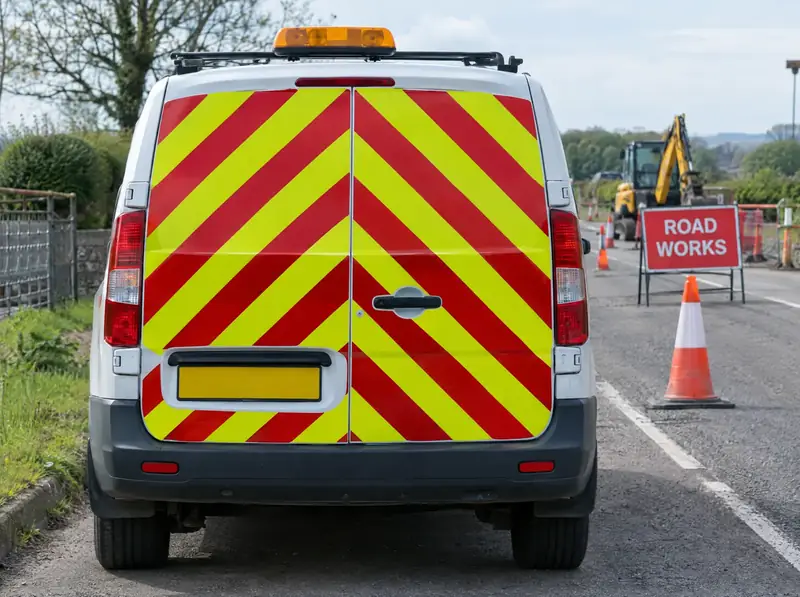
Chapter 8 chevrons are rear markings of alternating red and fluorescent yellow retroreflective material, with the chevrons pointing upwards, fitted to vehicles that stop or work on the highway under the Traffic Signs Manual's Chapter 8 guidance.
If your vehicles stop on the highway to work, whether for utilities, highway maintenance, surveying, traffic management or recovery, your clients and contracts may well ask for Chapter 8 rear markings. The pattern combines a fluorescent colour that stands out in daylight with retroreflective film that returns headlight beams, so drivers approaching from behind can pick out a stopped works vehicle.
We cut each kit to fit your vehicle rather than sticking on a generic, one-size sheet. Chevrons are laid out around door handles, rear lights, hinges, reversing cameras and the number plate, so nothing that must stay visible is covered. Before cutting anything, we check the specification written into your contract, because requirements can vary from one client to the next.
What is Chapter 8, and when does it apply to vehicles?
Chapter 8 of the Traffic Signs Manual is the guidance for vehicles that stop or work on the highway. Among other measures, it describes high-visibility rear markings, so drivers approaching from behind can recognise a stopped works vehicle in good time.
Whether your vehicles need them depends on the work you do and, very often, on your contracts. Highway authorities, utilities and main contractors commonly write Chapter 8 rear markings into their vehicle requirements, sometimes with extra detail of their own. The specification in your contract is the one to meet, so we ask for it before cutting anything.
- Highway maintenance and road-works vehicles
- Utility, telecoms and survey vans
- Traffic management and recovery vehicles
- Grounds and tree crews working on verges
What does a Chapter 8 rear marking look like?
It's a pattern of alternating red and fluorescent yellow stripes in retroreflective material, angled so the chevrons point upwards. The fluorescent yellow stands out in daylight and dull weather, and the retroreflective surface returns headlight beams to the driver at night.
Coverage, stripe widths and the grade of retroreflective material are set by the guidance and by your contract, and they can differ between clients. Rather than guess, we lay the kit out from the specification you send and show you a drawing of your rear doors before anything is cut. If the contract wording is unclear, ask your client to confirm it first.
- Red and fluorescent yellow, alternating
- Chevrons pointing upwards
- Retroreflective film, not standard printed vinyl
- Kept clear of lights, reflectors and the number plate
How are chevrons cut around handles, lights and the number plate?
Each kit starts from the rear of your exact vehicle, measured or taken from a template for the make, model and year. Chevrons are laid out to cover as much of the rear as is practical, then cut back around door handles, locks, hinges, rear lights, reversing cameras, sensors and the number plate and its lamp.
Where the rear doors meet, the pattern is split so it lines up when the doors are closed and each door still opens freely. Edges are pressed down firmly around every cut-out, because that's where dirt and pressure washing would otherwise start to lift the film.
- Barn doors: pattern split at the centre gap
- Tailgates: cut around the glass, wiper and lights
- Tipper bodies: applied to the tailgate and rear frame
Should you choose magnetic or permanent chevrons?
Permanent self-adhesive chevrons are usually the better choice for working vehicles. They're cut to fit, sit flat, stay put on the road and aren't easily lifted off, lost or stolen, so the vehicle is always ready for site.
Magnetic panels suit vehicles that only occasionally stop on the highway, but they have limits. They only hold to flat steel, so many aluminium, composite or ribbed rear doors won't take them, and grit trapped underneath can scratch the paint. They can also shift at speed or be left behind at the depot. Some contracts don't accept them, so check yours before choosing.
- Permanent: fitted once and cut around every fitting
- Magnetic: removable, flat steel doors only
- Magnetic: lift and clean underneath regularly
- Either way: confirm what your contract accepts
What about side and contour markings on larger vehicles?
Larger vehicles such as trucks, tippers and trailers may also carry side or contour markings, which are reflective strips that outline the vehicle's shape from the side or rear. These follow separate vehicle requirements and client rules rather than the rear chevron pattern alone.
We can fit side and contour markings alongside a rear chevron kit and plan them around existing livery and lettering. Because the requirements depend on the vehicle and the work, we ask what your contract and vehicle supplier specify before quoting. If your vehicles already have markings fitted from new, we work around them.
- Rear chevrons: the Chapter 8 pattern on the back
- Side markings: along the body sides of longer vehicles
- Contour markings: outlining the shape of the body
Options and finishes
Car-derived or small van kit
Chevrons cut to the rear doors or tailgate of a small van.
Medium or large van kit
Full rear-door coverage cut around handles, lights, hinges and the plate.
Truck or tipper rear kit
Chevrons on tailgates, rear frames or box bodies, shaped around fittings.
Permanent self-adhesive kit
Bonded directly to the doors; the usual choice for working fleets.
Magnetic chevron panels
Removable sheets for occasional use on flat steel doors only.
Side and contour markings
Extra markings for larger vehicles, fitted alongside the rear kit.
How much do Chapter 8 chevron kits cost?
Guide prices for a fitted Chapter 8 chevron kit run from £325 to £495 + VAT for a car-derived or small van, £395 to £695 + VAT for a medium or large van, and £595 to £895 + VAT for a truck or tipper rear.
Price depends on the area to be covered, how many cut-outs are needed around handles, lights and cameras, the grade of retroreflective film your contract specifies, whether old markings must come off, and how many vehicles are done in one visit. All figures are guides excluding VAT, confirmed when we have photos and your contract spec.
| Item | Guide, ex VAT | Inc. VAT (20%) |
|---|---|---|
| Car-derived or small van | £325 – £495 | £390 – £594 |
| Medium or large van | £395 – £695 | £474 – £834 |
| Truck or tipper rear | £595 – £895 | £714 – £1,074 |
Guide prices exclude VAT and are confirmed after survey or artwork check. Basis: red and fluorescent yellow retroreflective rear chevron kit, cut to the vehicle and fitted.
Permission and rules
Rear chevrons aren't usually an advertisement matter, so council consent doesn't come into it. What matters instead is Chapter 8 of the Traffic Signs Manual, the guidance for vehicles that stop or work on the highway, together with the specification in your contract. Highway authorities, utilities and main contractors often add their own requirements, so send us the exact wording before we cut anything. Markings are kept off windows and away from lights, reflectors and the number plate, which must stay clearly visible. Chevrons don't change a vehicle's main colour, so the V5C isn't affected. Whether you work in England, Wales, Scotland or Northern Ireland, treat your contract's spec as the standard and confirm it with your client.
Specification at a glance
| Typical size | Rear doors or tailgate of cars, vans, tippers and trucks, cut to each vehicle |
|---|---|
| Materials | Red and fluorescent yellow retroreflective film, chevrons pointing upwards |
| Typical lifespan | Depends on film grade and wear; check the manufacturer rating and inspect regularly |
| Typical lead time | typically 3–10 working days from approved layout; fitting typically 1–3 hours |
| Fixing / installation | Permanent self-adhesive preferred; magnetic panels only where your contract accepts them |
| Consent | Not an advertisement matter; follow Chapter 8 and your contract's exact spec |
Before you ask for a quote
- The exact rear-marking wording from your contract or your client's vehicle standard
- Vehicle make, model, year and rear type: barn doors, tailgate or tipper body
- A straight-on photo of the rear, doors closed, showing handles, lights and plate
- Permanent or magnetic, and whether your contract allows magnetic markings
- Any branding or phone number you want kept on the rear