
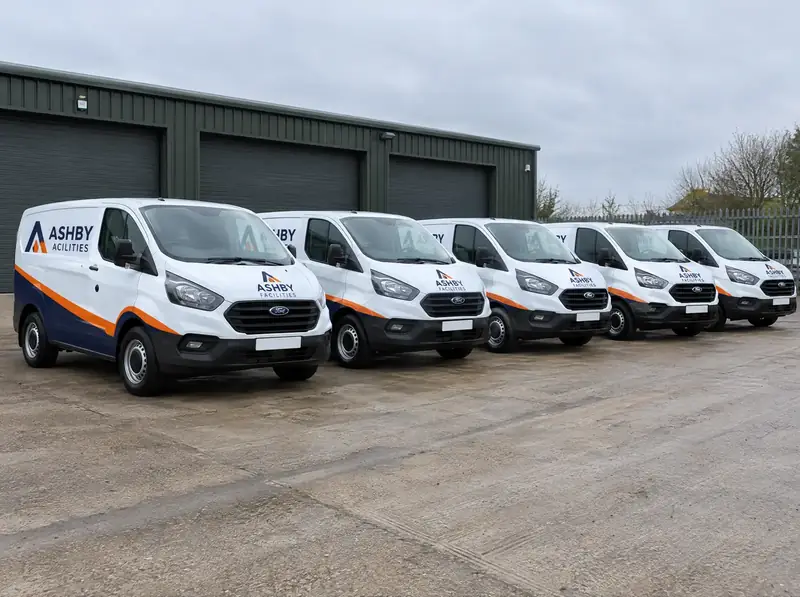
Fleet livery is a consistent set of vehicle graphics, produced from master templates for each vehicle model, so every van, car, truck or trailer a business runs carries the same branding in the same position.
When two of your vehicles park side by side, the logo should be the same size, the colours the same shade and the phone number in the same place. Fleet livery is how that happens. It takes your brand guidelines and turns them into a fixed, approved layout for every vehicle type you run, from pool cars to tippers and trailers.
We set up a master template for each model, agree a roll-out order with you, and keep a record of the films and print settings used. A van added next year, or a panel replaced after a scrape, can then be matched to vehicles already on the road. We can usually arrange fitting at your depot, so vehicles are done in batches rather than sent away.
How do brand guidelines become vehicle graphics?
Brand guidelines are written for screens and paper, so they need translating for vehicles. Logo clear space, typefaces and colour references become rules about where the logo sits, how big the phone number is and which film colours are used.
Colour is the part that needs most care. Solid vinyl comes in fixed shades, while printed film can be tuned, so we match each brand colour to a film or print setting and show you samples on the actual material. Once you've signed those off, the same references are used for every vehicle.
- Approved colour references for cut and printed film
- Minimum sizes for the logo and phone number
- Separate rules for white and dark-coloured vehicles
- Placement rules for rear doors and tailgates
Why does each vehicle model need its own master template?
Each model has its own door lines, handles, windows and ribbed panels, and many change at a facelift. A master template is a scale drawing of one model and year range with your livery laid out on it, approved once and reused for every matching vehicle.
Templates keep vehicles consistent even when different fitters work on them, and they cut design time when you add vehicles. A mixed fleet might need templates for a pool car, a small van, a long-wheelbase van and a tipper, each carrying the same brand elements in proportion.
- One template per make, model, year range and body style
- Version numbers recorded whenever a design changes
- Templates for trailers, curtain sides and box bodies as well as vans
How can livery roll out without losing vehicles for days?
By phasing it. Rather than taking the whole fleet off the road, we agree an order: new vehicles first, then those with the oldest graphics, then the rest, in batches sized to what your operation can spare.
We can usually arrange fitting at your depot, which saves drivers delivering and collecting vehicles. It needs a covered, dry space with room to work around each vehicle and access to power. Lettering-led livery is typically fitted in a few hours per vehicle; part-wrap livery typically takes a day or more, so batches are planned around shift patterns.
- New and replacement vehicles: liveried before they enter service
- Existing vehicles: grouped by model so templates run efficiently
- Out-of-hours fitting: discussed where your site allows it
What happens when a liveried vehicle is damaged?
After a scrape or a body repair, only the affected panel needs replacing. Because the template, film references and print settings are on record, a new panel can be printed to match and fitted to the repaired vehicle.
Expect a small difference between new print and graphics that have been in the sun for a few years, especially on strong colours. Where the difference would show, replacing the whole side or door rather than a small patch usually gives a better match. Ask the body shop to tell you before it removes graphics, so new ones can be ready when the repair is done.
- Photos of the damaged area and the whole side
- The vehicle registration, so we can find its template
- Whether paintwork has been redone, and when
What happens to livery at de-fleet?
When vehicles are sold or returned at the end of a lease, the livery usually has to come off. Planning for that from the start, by using removable cast film on sound paint and keeping fitting records, makes de-fleet removal far more predictable, for you and for the lease company.
We can remove livery in batches as vehicles leave, clean off the adhesive and point out any ghosting before the vehicle goes back. Good records help here: knowing what was fitted, when and on which vehicle makes it easier to plan removal and to answer questions from lease companies.
- Registration and fitting date for each vehicle
- Template version and films used
- Any panels replaced since first fitting
- Lease end dates, so removal is booked in time
Options and finishes
Lettering-led livery
Cut vinyl name, services and contact details applied identically to each vehicle.
Part-wrap livery
Printed graphics on the sides and rear, with the factory colour as background.
Full-wrap livery
Every vehicle wrapped in brand colours, useful when vehicles arrive in mixed colours.
Mixed fleet scheme
One brand look adapted for cars, vans, trucks and trailers.
Chapter 8 integration
Rear chevrons designed into the livery for vehicles that work on the highway.
De-fleet removal
Livery taken off in batches as vehicles are sold or returned.
How much does fleet livery cost?
Fleet livery is priced per vehicle. Lettering-led livery is a guide £225 to £595 + VAT per vehicle, and part-wrap livery is typically between £695 and £1,650 + VAT per vehicle. A one-off fleet design and template set-up is from £195 to £650 + VAT.
The per-vehicle cost depends on vehicle sizes, coverage, how many different models need templates, where fitting happens and whether old graphics come off first. These are guide figures excluding VAT; your per-vehicle price is confirmed from the vehicle list and approved artwork.
| Item | Guide, ex VAT | Inc. VAT (20%) |
|---|---|---|
| Lettering-led livery, per vehicle | £225 – £595 | £270 – £714 |
| Part-wrap livery, per vehicle | £695 – £1,650 | £834 – £1,980 |
| Fleet design and template set-up (one-off) | £195 – £650 | £234 – £780 |
Guide prices exclude VAT and are confirmed after survey or artwork check. Basis: matching graphics across several vehicles; rate depends on coverage and fleet size.
Permission and rules
For a working fleet, the council isn't usually involved: livery on vehicles normally used as moving vehicles sits outside advertisement control, though the regulations are written separately for England, Wales, Scotland and Northern Ireland. The exception is a vehicle parked mainly as a static advert, such as a spare van left beside a main road, so ask the council before using one that way. Where livery changes a vehicle's main colour, its V5C needs updating with DVLA and your insurer needs telling. Each lease may set its own terms on graphics and their removal. Vehicles that pull up to work on the road may also need Chapter 8 rear markings, so check what your contracts ask for.
Specification at a glance
| Typical size | From two vehicles to mixed fleets of cars, vans, trucks and trailers |
|---|---|
| Materials | Cut and printed cast vinyl, laminated, colour-matched to your brand guidelines |
| Typical lifespan | Cast films commonly manufacturer-rated around 5–7 years on vertical panels; replacements matched from records |
| Typical lead time | typically 2–4 weeks for templates and proofs; roll-out phased to your schedule |
| Fixing / installation | We can usually arrange fitting at your depot, under cover, in batches |
| Consent | Not usually needed for working vehicles; a main-colour change means a V5C update |
Before you ask for a quote
- A vehicle list with make, model, year and registration for each vehicle type
- Your brand guidelines, logo files and colour references
- How many vehicles you can release at once, and when
- Whether your depot has covered, dry space with power for fitting
- Lease terms on graphics and any contract requirements such as Chapter 8 markings