
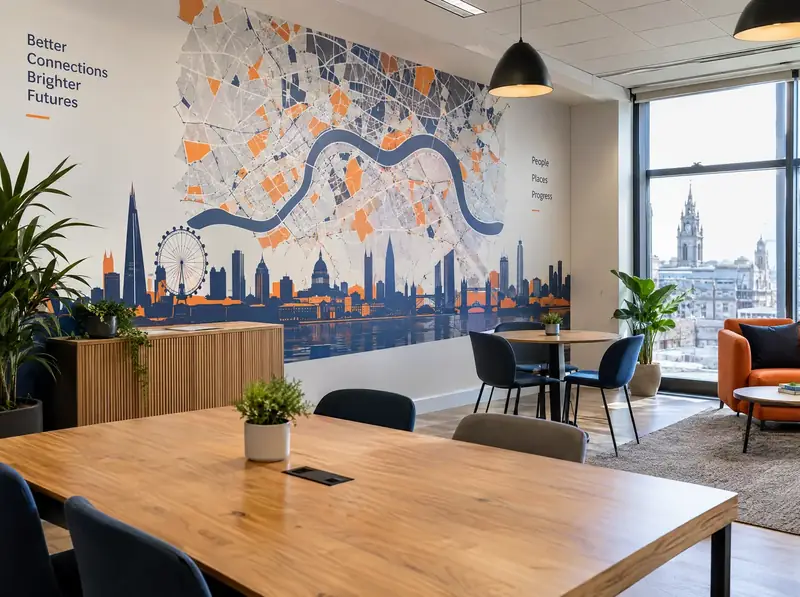
Wall graphics are large printed images, patterns or lettering applied to walls as self-adhesive vinyl or printed wallpaper, to brand a space, guide visitors or turn a plain wall into a feature.
Blank walls are wasted space. A printed mural can carry your brand into reception, give a gym floor its energy, make a school corridor easier to navigate, or turn a breakout area into somewhere people choose to sit. Because it is printed to the exact wall size, a graphic can wrap around corners, frame doors and line up with furniture.
The result depends on the wall as much as the print. Vinyl and wallpaper both need a sound, smooth, fully cured surface, and corridors and stairways bring fire-safety questions about wall finishes. This page covers choosing a material, preparing walls, textured and brick surfaces, when to ask for a fire classification, cut vinyl lettering for wayfinding, and how removal works.
Vinyl or wallpaper: which suits your wall?
Self-adhesive vinyl is the more flexible choice. It goes onto smooth painted walls, glass and some panels, trims neatly around sockets and doors, and with a removable adhesive comes off later without stripping. Laminated, it stands up to wiping and scuffs in busy areas.
Printed wallpaper is pasted in drops that butt together, like ordinary wallpaper. It suits large, long-term murals and gives a flat, matt finish without the slight sheen of vinyl. Some printed wallpapers are made to be strippable, which helps when the design changes.
- Removable vinyl: rented offices, campaigns and frequent rebrands
- Laminated vinyl: gyms, corridors, schools and hard-wearing areas
- Printed wallpaper: large murals and feature walls
- Cut vinyl lettering: values, quotes and wayfinding text with no background
How should walls be prepared?
The wall needs to be smooth, clean, dry and sound, because a graphic is only as good as the surface beneath it. That means no flaking paint, unsanded filler or building dust. Walls with damp, condensation or salts coming through need the cause fixing first.
Fresh paint is the most common trap. Paint needs to cure, not just feel dry, before vinyl will bond properly; applied too soon, vinyl can trap solvents that cause bubbles or a weak bond, and the paint may lift when the graphic is removed. Follow the paint maker's curing guidance and, as a rough guide, allow at least a couple of weeks.
Some wipeable or stain-resistant paints resist adhesives, so we test a patch first and choose the adhesive to suit.
Can graphics go on textured or brick walls?
Not with standard wall vinyl. On textured plaster, woodchip, brick or block, ordinary vinyl bridges across the dips and soon lifts, so a different material is needed. For brick and block there are conformable films made to be heated and pressed into the texture.
On lightly textured plaster, printed wallpaper often works better than vinyl; where neither suits, the graphic can be printed on a rigid panel and fixed to the wall. Outside walls are a separate case, with weather, UV and advertisement consent to consider.
- Smooth painted plaster or plasterboard: standard vinyl or wallpaper
- Light texture: printed wallpaper, or vinyl after a patch test
- Brick and block: conformable textured-wall film, heat-applied
- Very rough or uneven surfaces: a printed panel fixed to the wall
Do wall graphics need to meet fire rules?
They can, particularly in corridors, stairways and other escape routes. Building regulations guidance in each UK nation limits how readily wall linings let flame spread, and escape routes are treated most strictly. Whoever is responsible for the building's fire risk assessment needs to be satisfied with any new finish.
Where it matters, ask for the material's fire classification. Many wall vinyls and wallpapers are tested and classified on a stated background, such as plasterboard, and we can supply the data sheet so your fire risk assessor, building control or landlord can check it against the location.
Schools, hospitals, care settings and venues often set their own requirements, so tell us early if the graphic is going in a corridor or stairway.
How does cut vinyl wall lettering work?
Cut vinyl lettering is text or simple shapes cut from coloured vinyl with no background, so the wall shows through between the letters. It suits company values in a meeting room, a welcome line in reception, floor numbers by a lift or room names along a corridor.
For wayfinding, keep text large and in a clear typeface, with strong contrast against the paint, and place it where people look as they walk: around eye level and at junctions. Matt finishes reduce glare under office lighting.
Removal is simple on sound paint: lettering or graphics are warmed and peeled, and the adhesive cleaned off. On older or poorly bonded paint some may come away, so plan for a touch-up after removing a long-term graphic.
Options and finishes
Printed wall vinyl
Laminated self-adhesive print for feature walls.
Wallpaper murals
Printed drops for large, long-term murals.
Removable wall vinyl
Low-tack adhesive for rented space.
Textured-wall film
Conformable film heated into brick or block.
Cut vinyl lettering
Values, room names and wayfinding text.
How much do wall graphics and murals cost?
Printed wall graphics are guided at £38–£82 per m², supplied, laminated and fitted to suitable smooth walls, excluding VAT, with a £245 + VAT minimum. Cut vinyl wall lettering is guided at £145–£650 + VAT, depending on the amount of text.
Area, wall preparation, material, design time, sockets and doors, stairwell access and fire-classified materials all count; the price is confirmed after survey and artwork approval.
| Item | Guide, ex VAT | Inc. VAT (20%) |
|---|---|---|
| Printed wall graphic, per m² | £38 – £82 | £45.60 – £98.40 |
| Minimum job | £245 | £294 |
| Cut vinyl wall lettering | £145 – £650 | £174 – £780 |
Guide prices exclude VAT and are confirmed after survey or artwork check. Basis: printed wall vinyl or wallpaper, laminated, fitted to suitable smooth walls. Minimum job £245 + VAT.
Permission and rules
Graphics on interior walls usually fall outside advertisement control, so planning consent is rarely the question indoors. The checks are fire performance in escape routes, your lease, and listed status: listed building consent covers interiors too, so ask the council before fixing to historic surfaces. A branded graphic on an outside wall is normally treated as an advertisement; in England it falls under the 2007 regulations, and large graphics may need express consent. Wales, Scotland and Northern Ireland have their own rules. If consent is needed, we can prepare the drawings and photos or submit the application for you.
Specification at a glance
| Typical size | Single feature walls to full corridors |
|---|---|
| Materials | Printed vinyl or wallpaper; cut vinyl; textured-wall film |
| Typical lifespan | Typically several years indoors by manufacturer ratings; laminate copes with cleaning |
| Typical lead time | typically fitted 2–3 weeks after design approval |
| Fixing / installation | Applied to smooth, sound, fully cured paint |
| Consent | Rarely needed indoors; fire classification and listed status checked |
Before you ask for a quote
- Measure each wall, noting doors, sockets and radiators.
- Photograph each wall, plus a close-up of its surface.
- Find out when the wall was last painted.
- Say if the wall is on an escape route.
- Send logos, images and wording, or a brief.