
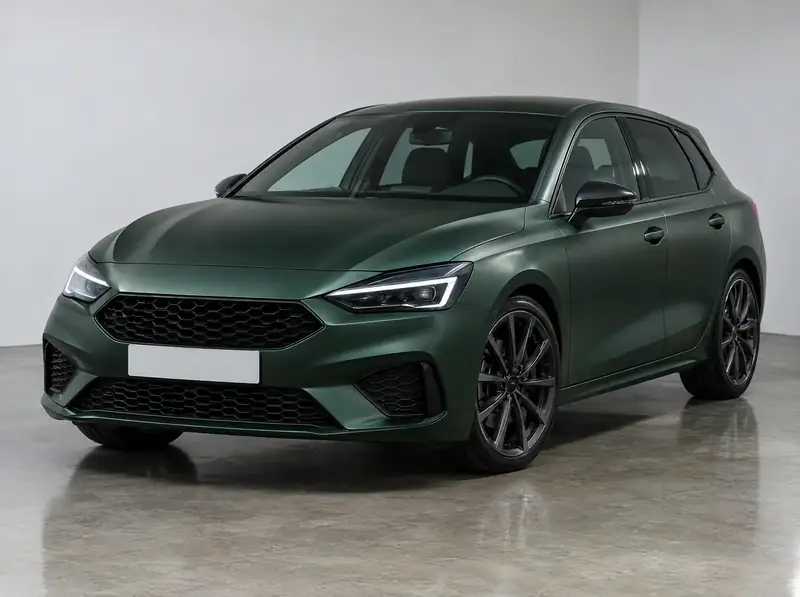
A car wrap is a thin cast vinyl film applied over the factory paint to change the car's colour or finish, either across every panel or on selected parts such as the roof or mirrors.
Colour-change film gives your car a finish the factory may never have offered, from satin black and matt grey to a metallic or a colour-shift that changes with the light, without a respray. The film is made in the colour rather than printed, so the finish is even across every panel. Because it sits on top of the original paint, it can come off later to reveal the colour underneath.
How good a wrap looks comes down mostly to the edges. Fitters take off badges, lights or handles where needed so film can be tucked neatly out of sight, and keep joins to places you won't notice. Door shuts, the painted frames you see when a door opens, stay in the original colour unless you add them, and they're quoted separately as an extra.
How do you choose a colour and finish?
Choose from real film samples held against the car in daylight. Screens and small swatches mislead, especially with metallic and colour-shift films, which change with the viewing angle and the light.
Think about how each finish lives day to day. Gloss is the easiest to keep clean and behaves most like paint. Satin hides fine swirl marks and gives a soft sheen. Matt looks striking but shows greasy fingerprints and can't be polished, so marks have to be washed out rather than buffed. Metallic and colour-shift films cost more and need the most care around edges.
- Look at the sample on a curved panel, not just a flat one
- Check the colour in shade as well as in sunlight
- Consider how it will sit with your wheels, glass and trim
What can you wrap besides a full colour change?
Part wraps change the look of a car for a fraction of the cost of a full colour change. A gloss black roof, mirror caps or bonnet is the most common combination, and two or three of these together can change a car's character more than you'd expect.
A chrome delete covers window surrounds, grille bars and badges in black or a body-coloured film. It's a popular change on cars whose chrome trim has started to look dated or pitted. Business owners can also add lettering or a small logo on top of a colour change, or straight onto the factory paint.
- Roof in gloss black or carbon-effect film
- Mirror caps and spoilers
- Bonnet stripes or a full bonnet
- Chrome window trim and grille bars
Is your paint in good enough condition to wrap?
Wrap film is thin, so it shows what's underneath. Stone chips, deep scratches and small dents appear as bumps or dips through the film, and rust carries on spreading under it. Small chips can usually be filled and flatted before fitting so they show less.
The bigger concern is paint that isn't firmly bonded. A cheap respray, flaking clear coat or a panel that has had a smart repair can lift when the film is removed years later, taking paint with it. We look at the car, or detailed photos, before quoting and tell you about any panels that carry a risk.
- Original factory paint gives the most predictable result
- Recently resprayed panels usually need time to cure before wrapping
- Peeling lacquer needs repairing first, not covering
Why are door shuts quoted separately?
Door shuts are the painted frames and edges you see when a door, boot or bonnet is open. A standard wrap stops at the outer edges, so a change from white to black, for example, shows a white frame every time you open the door.
Wrapping the shuts means lifting seals and trim in places and working film into tight, layered areas, which adds days to the job and cost to the quote. Many owners skip them on a subtle change, such as grey to a darker grey, and add them when the contrast would be obvious.
- Door shuts: the frames around each door opening
- Boot and bonnet shuts: often done with the doors for a complete finish
- Fuel-filler recess: worth including on a strong contrast change
How do you look after a wrapped car, and remove it later?
Matt and satin films need the most thought, because they can't be polished or waxed without leaving shiny patches; marks are washed out rather than buffed away. Every finish prefers a hand wash, with pressure-washer lances kept well away from edges, seams and badges, where water can lift the film. Brush car washes and cutting compounds are best avoided.
When it's time for a change, the film is warmed and peeled off at a low angle, and any adhesive is cleaned away. On sound factory paint within the film's rated life, it usually leaves the original colour as it was. Remember to change the V5C back if you'd recorded a new colour.
- Wait a few days before the first wash
- Clean off bird droppings and tree sap promptly
- Park in shade or a garage when you can
Options and finishes
Gloss
A paint-like shine and the easiest finish to keep clean.
Satin
A soft sheen that hides fine swirl marks.
Matt
Flat and striking; washed clean rather than polished.
Metallic
Flecked film that catches the light like metallic paint.
Colour-shift
Changes colour with the viewing angle; needs the most care.
Part wrap
Roof, mirrors, bonnet or a chrome delete on window trim and grille.
How much do car wraps and colour change cost?
Guide prices for a full colour change run from £1,950 to £2,850 + VAT for a small or medium car, and from £2,650 to £3,750 + VAT for a large car or SUV. Roof, mirrors or bonnet only is typically between £195 and £650 + VAT.
Price rises with the size of the car, complex bumpers and deep curves, how much trim has to come off, and the film itself, as metallic and colour-shift films cost more than gloss. Door shuts are quoted separately. All prices exclude VAT and are confirmed once we've seen the car or detailed photos.
| Item | Guide, ex VAT | Inc. VAT (20%) |
|---|---|---|
| Full colour change, small or medium car | £1,950 – £2,850 | £2,340 – £3,420 |
| Full colour change, large car or SUV | £2,650 – £3,750 | £3,180 – £4,500 |
| Roof, mirrors or bonnet only | £195 – £650 | £234 – £780 |
Guide prices exclude VAT and are confirmed after survey or artwork check. Basis: full colour-change wrap in gloss, satin or matt cast film; door shuts quoted separately.
Permission and rules
A plain colour change isn't an advertisement, so the council isn't usually involved. Branding on a car you drive for work is normally outside advertisement control too. A branded car left mostly in one spot as an advert is another matter, and England, Wales, Scotland and Northern Ireland each have their own rules, so ask the council first. The rules that do apply are DVLA's: if the wrap changes the car's main colour, the V5C log book has to show the new colour, and your insurer needs to know too. On a leased or financed car, read what the agreement says about wraps and returning the car. Wrap film stays off the windscreen and front side windows.
Specification at a glance
| Typical size | Superminis to large SUVs; full colour change, or roof, mirrors and bonnet only |
|---|---|
| Materials | Cast colour-change film in gloss, satin, matt, metallic or colour-shift |
| Typical lifespan | Manufacturers commonly rate cast films around 5–7 years on vertical panels; roof and bonnet less |
| Typical lead time | typically 1–3 weeks to source film; fitting typically 2–4 days |
| Fixing / installation | Fitted indoors on clean, sound paint; badges and trim removed where needed |
| Consent | Not usually a council matter; update the V5C and insurer if the colour changes |
Before you ask for a quote
- Your car's make, model and year, and any body kit or trim level
- The colour and finish you want, with a reference photo if you have one
- Close-up photos of chips, scratches, lacquer peel or previous repairs
- Whether to include door shuts, or only the roof, mirrors or chrome
- Any lease or finance terms about modifications and returning the car