
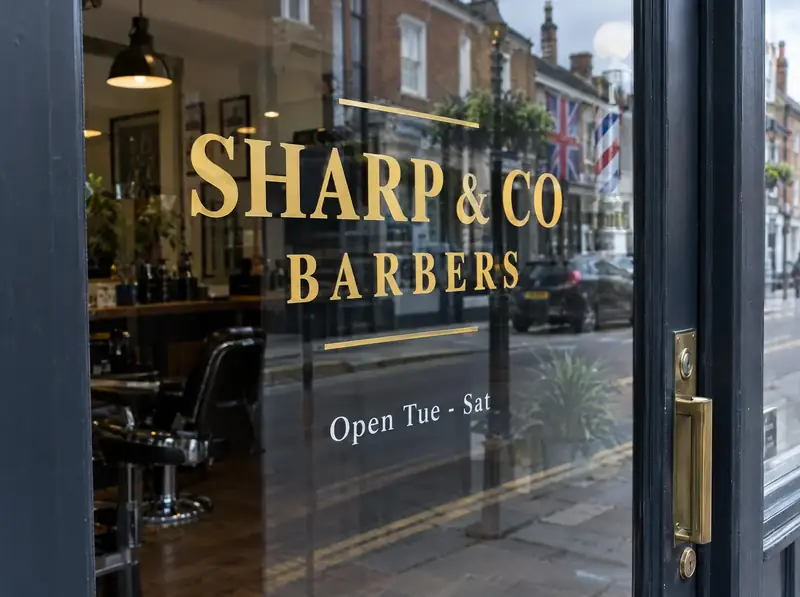
Window lettering is text or simple logos cut from self-adhesive vinyl, with no background film, applied to glass doors and windows to show a name, opening hours and contact details.
Lettering on the glass answers the questions people have at the door: who you are, when you're open and how to reach you. Cut vinyl does it with no background film, just letters on clear glass, so the window still looks like a window. It suits barbers, salons, cafés, estate agents, solicitors, dental practices and any business with a glazed entrance.
Most of the skill is in size and placement. Opening hours are read at arm's length, a business name has to work from the far pavement, and a phone number has to survive reflections. The sections that follow deal with letter sizes, fonts and finishes such as gold, placement on a door, what to say, and changing one line when details change.
How big should window lettering be?
Size it for the distance it will be read from. Opening hours on a door are read from a step or two away, so modest capitals work; a business name on the window has to register from across the street, often at an angle and through reflections.
Cut vinyl has a lower limit too. Below about 10 mm tall, fine details such as the inside of an 'e' are hard to peel and fit cleanly, and tend to lift. Long small print is neater printed on clear film.
- Opening hours on a door: about 20–30 mm capital height
- Phone number or website: about 30–50 mm
- Business name across a shop window: about 75–150 mm
- Wide frontages or upper floors: larger again
Which fonts and colours read well on glass?
Bold, open letterforms survive the trip across a street; hairline scripts and tightly condensed fonts don't. Glass reflects the sky and buildings opposite, washing out thin strokes, so lettering needs a heavier weight than on paper.
Contrast matters as much as size. White reads well against a dim interior; black suits glass with a bright space behind. Gold and silver vinyls look rich but can vanish against a pale interior, so they are often outlined in black. Frosted vinyl gives a quieter, etched look.
For a hand-painted look, traditional typefaces can be cut in two layered colours, with outlines and drop shadows that mimic signwriting. Script logos can still be cut if the joins between letters are thick enough to hold together.
Where should lettering sit on a door?
Put information where eyes already go. On a door, opening hours usually sit between chest and eye height on the opening side, clear of the handle and push plate, so hands don't hide or wear them. The name goes higher, or across the fanlight above.
On a shop window, the name usually runs across the upper part of the glass, where display stands and parked cars won't block it, with a margin from the frame so the letters don't look cramped.
Outside application gives the crispest finish. Inside application protects lettering from weather and window cleaners, but the letters are cut in mirror image and, from inside, you see the back of the vinyl, which can look grey on metallic films.
What if your details change?
Change one line, not the whole door. Each line of cut vinyl is a separate piece, so new hours or a new number can be taken off with gentle heat and replaced while the rest stays put, matched in font and colour to the original.
Plan for change at the design stage by keeping the details most likely to move in their own block, rather than locking them into a logo layout.
- Opening hours: one line per day, or a grouped block that can be swapped
- Phone, website and social handles: set below the name, not built into it
- Seasonal lines such as Christmas hours: cut from removable-adhesive vinyl
- Services lists: one line each, so one can be added or dropped
What should door lettering say?
Less than you might think. Passers-by give a window a second or two, so the lettering should answer three questions: what is this place, is it open, and how do I contact it? Everything else competes for that glance.
A useful order runs from most to least important: name, what you do, opening hours, then phone and website. Social handles and payment logos can be kept small and low, or left off. Write the wording out in full before asking for a quote, as the number of characters affects the price.
- Name and trade: 'Barbers' or 'Dental practice' tells strangers what you are
- Hours: written the same way for every day, with closed days stated
- Contact: one phone number and one web address
Options and finishes
Door set
Name, opening hours and a contact line.
Window set
Name, trade and services across the glass.
Gold and metallic
Metallic vinyl, often outlined in black.
Frosted lettering
Etch-effect vinyl that looks sandblasted.
Two-colour traditional
Outlines and shadows imitating hand-painted signs.
How much do window and door lettering cost?
Door lettering with opening hours is guided at £95–£245, and a full window set at £195–£480, supplied and fitted, excluding VAT. Gold or metallic vinyl adds a guide £30–£120 + VAT.
Price moves with characters and lines, fine detail, outlines, the number of doors and windows, and old lettering to remove; it's confirmed once we have photos and wording.
| Item | Guide, ex VAT | Inc. VAT (20%) |
|---|---|---|
| Door lettering and opening hours | £95 – £245 | £114 – £294 |
| Full window lettering set | £195 – £480 | £234 – £576 |
| Gold or metallic effect vinyl | £30 – £120 | £36 – £144 |
Guide prices exclude VAT and are confirmed after survey or artwork check. Basis: cut vinyl lettering and opening hours for a door or window. Minimum job £95 + VAT.
Permission and rules
Door and window lettering can count as an advertisement in planning terms, but small lettering on your own business premises rarely raises consent questions. In England, non-illuminated signs on business premises usually have deemed consent if the lettering is no taller than 0.75 m (0.3 m in an area of special control) and the top is no higher than the bottom of any first-floor window, so upper-floor lettering is worth checking. Listed shopfronts may need listed building consent. Wales, Scotland and Northern Ireland have their own regulations with different details. We check before anything is cut.
Specification at a glance
| Typical size | Door sets around 600 by 400 mm; names 75–150 mm tall |
|---|---|
| Materials | Cut vinyl: colours, metallics and etch-effect frost |
| Typical lifespan | Typically several years outdoors by manufacturer ratings |
| Typical lead time | typically 5–10 working days from proof approval |
| Fixing / installation | Applied with transfer tape, inside or outside the glass |
| Consent | Usually deemed consent in England; listed shopfronts checked |
Before you ask for a quote
- Measure the clear glass on each door and window.
- Photograph the door straight on, tape measure in shot.
- Write out the exact wording, with hours for each day.
- Choose plain colour, gold, metallic or frosted.
- Note your brand font and colours.