
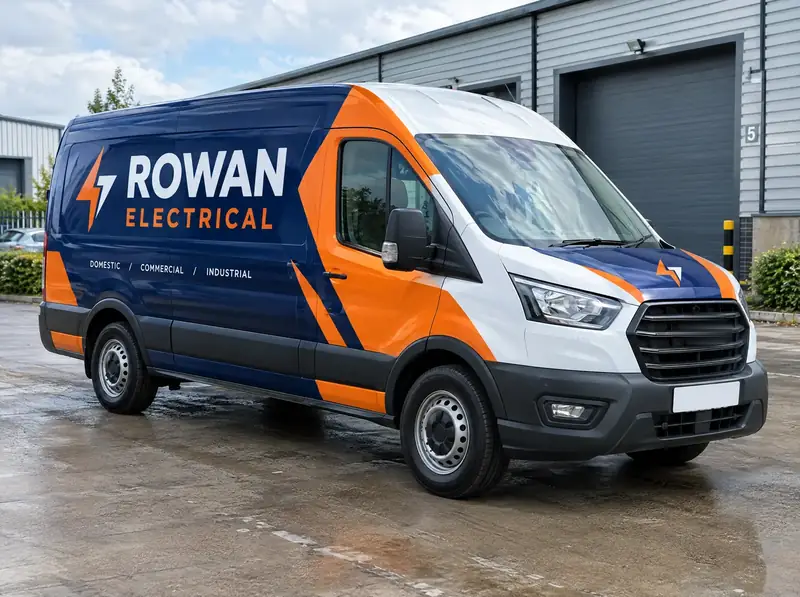
A van wrap is printed cast vinyl film, protected by a clear laminate, applied over a van's factory paint to cover some or all of its panels with your branding, colours and contact details.
Your van is parked outside every job you do, so a wrap turns it into a sign that travels with you. A part wrap covers the sides and rear with printed graphics over your existing paint colour; a full wrap covers almost every painted panel. Both use the same cast film, which is thin and flexible enough to follow pressed curves, recesses and the shapes around handles and lights.
We start from a scale template of your exact make, model, wheelbase and roof height, so artwork doesn't land across a door gap or a rivet line by accident. You approve a proof showing every side before anything is printed. The printed panels are laminated, then fitted under cover by wrap installers working under our contract, at your premises if there's suitable space or at another agreed location.
Should you choose a full wrap or a part wrap?
Choose a part wrap when your van's factory colour already works as a background. Printed graphics cover the sides and rear doors, and the paint fills in the rest of the design, which keeps the price well below a full wrap.
A full wrap suits a colour the van wasn't built in, a photographic design that runs from bonnet to rear doors, or a clean break from old livery. It covers almost every painted exterior panel; door shuts and the inside edges of doors usually stay in the original colour.
- Part wrap: sides and rear printed, with the factory paint showing as part of the design
- Half wrap: the back half of the van covered, popular on long-wheelbase vans
- Full wrap: bonnet, roof line, sides, rear and any painted bumpers covered
Why does your van's exact model and year matter?
Panel shapes differ between models and often change at a facelift, so every design starts from a scale template of your exact make, model, year, wheelbase and roof height. The template shows where door handles, fuel caps, rivets, swage lines and ribbed sections fall.
Working to it stops a phone number running into a sliding-door handle or a logo being split by the gap between the rear doors. Deeply ribbed panels need the film worked into every channel, so we either design around them or allow extra fitting time.
- Your registration lets us confirm the exact model before design starts
- Sliding doors on one or both sides change the side layout
- Glazed or solid rear doors change what fits on the back
- Roof racks, ladders and bolt-on steps can hide graphics
What makes a van wrap readable on the move?
A readable wrap lets someone in the next lane take in your name, your trade and your number in a few seconds. Keep the business name, two or three services and one phone number large, and put the website and social handles smaller.
The rear doors deserve the most thought, because drivers stare at them in queues. Put the number high on the doors, clear of the handles and number plate, with strong contrast between text and background. Busy photographs behind lettering are the usual reason a design looks good on screen but reads badly on the road.
- Dark text on a light panel, or light text on dark
- One phone number rather than a list
- A short web address without 'https://'
Does a wrap protect the paint, and does it come off cleanly?
While it's on, a wrap covers the factory paint and helps shield it from light scuffs and sun fade. That can help when the van is later sold or handed back, because most panels have been covered for most of their working life.
Cast film is designed to come off with gentle heat, and it usually releases cleanly from sound factory paint within its rated life. Resprayed panels, chips, rust or failing lacquer are different, because they can lift with the film, so we check the paint before quoting. Leaving a wrap on long past its rated life makes removal slower and leaves more adhesive behind.
- Tell us about any previous repairs or resprays
- Point out stone chips on the bonnet and front edges
- Check your lease terms on graphics before design starts
How should you wash a wrapped van?
Hand washing with a pH-neutral vehicle shampoo and a soft mitt is the gentlest routine. Rinse grit off first so it isn't dragged across the laminate, and dry with a clean microfibre cloth.
A pressure washer is fine if you keep the lance well back and never aim it straight at an edge or seam, where water can get under the film. Brush car washes can catch film edges on the rear doors and around handles, so avoid them where you can.
- Wait a few days after fitting before the first wash
- Skip cutting polishes and solvents, and never wax matt or satin finishes
- Clean off bird droppings, tree sap and fuel spills promptly
- Park out of direct sun when you can; roofs and bonnets age fastest
Options and finishes
Part wrap
Sides and rear printed over your factory paint, which does part of the design work.
Full wrap
Almost every painted exterior panel covered, for a new colour or an end-to-end design.
Colour change plus graphics
Plain coloured film over the whole van, with printed or cut graphics on top.
Gloss, satin or matt laminate
The laminate finish changes how colours look and how easily the van wipes clean.
Reflective details
Retroreflective film for stripes or lettering that shows up in headlights.
How much do van wraps cost?
Guide prices start from £795 + VAT for a part wrap covering the sides and rear, typically up to £1,850 + VAT depending on van size and coverage. A full wrap is typically between £1,950 and £2,950 + VAT on a small or medium van, and £2,450 to £3,850 + VAT on a long-wheelbase or high-roof van.
The main drivers are van size, how much is covered, how complex the panels are, design time and whether old graphics have to come off first. Ribbed sides and deep recesses take longer to fit. All prices exclude VAT and are confirmed after we've checked your van details and artwork.
| Item | Guide, ex VAT | Inc. VAT (20%) |
|---|---|---|
| Part wrap (sides and rear) | £795 – £1,850 | £954 – £2,220 |
| Full wrap, small or medium van | £1,950 – £2,950 | £2,340 – £3,540 |
| Full wrap, long-wheelbase or high-roof van | £2,450 – £3,850 | £2,940 – £4,620 |
Guide prices exclude VAT and are confirmed after survey or artwork check. Basis: printed cast vinyl, laminated; part wrap to full wrap depending on van size.
Permission and rules
A wrap on a working van isn't usually a council matter: graphics on a vehicle normally used as a moving vehicle are outside advertisement control. A van parked up mainly to act as a roadside billboard is treated differently, and the rules are set separately in England, Wales, Scotland and Northern Ireland, so check with the council before using a van that way. If a full wrap changes the van's main colour, DVLA needs the new colour on the V5C log book, and your insurer should be told as well. A leased van may have terms on graphics and their removal, so read those first. Graphics stay off the windscreen and front side windows.
Specification at a glance
| Typical size | Small panel vans to long-wheelbase high-roof vans; part or full coverage |
|---|---|
| Materials | Printed cast vinyl with clear gloss, satin or matt laminate |
| Typical lifespan | Manufacturers commonly rate cast wrap film around 5–7 years on vertical panels; roofs age faster |
| Typical lead time | typically 1–3 weeks from approved proof; fitting typically 1–3 days per van |
| Fixing / installation | Applied under cover over clean, sound factory paint, with edges worked into recesses |
| Consent | Not usually needed for a working van; update the V5C if the main colour changes |
Before you ask for a quote
- Your van's make, model, year, wheelbase and roof height, or the registration so we can check
- Daylight photos of both sides, the front and the rear doors
- Logo files, brand colours, and the wording, phone number and website you want shown
- Part wrap or full wrap, and whether the main colour will change
- Any dents, rust, resprays or old graphics we should know about