
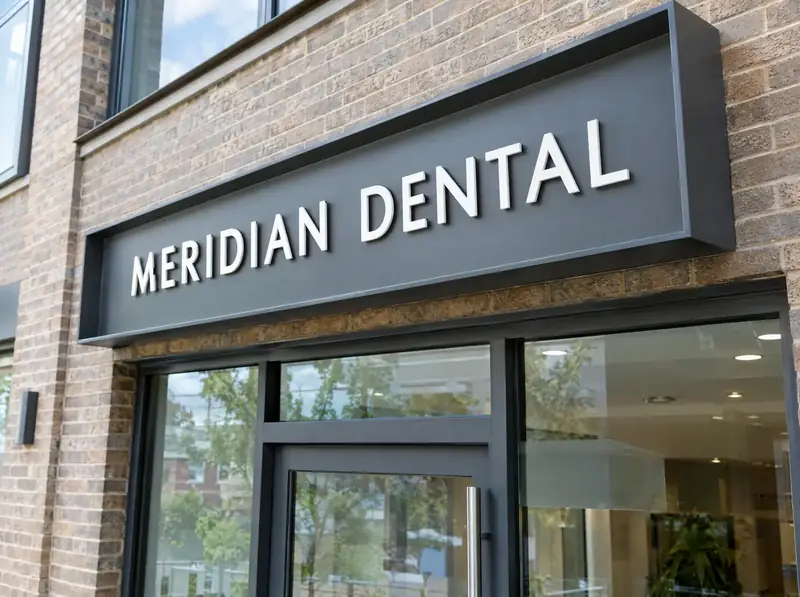
Tray signs are fascia signs folded from aluminium sheet so the face turns back at the edges into returns, typically 50–75 mm deep, then powder coated and hung on concealed fixings.
Look closely at a shopfront that seems more expensive than its neighbours and the sign is often a tray: a shallow box of aluminium with crisp edges and no screws on show. The depth casts a slight shadow line along the fascia, giving the frontage a finished, architectural look that a flat panel can't quite match. Clinics, agents and offices use them for the same reason.
We draw the tray to your fascia, have it folded and powder coated to a RAL colour, and fit it on concealed fixings. Lettering can be applied vinyl, raised acrylic stood proud of the face, or routed through the metal, and the tray can be built so lighting is easy to add later. Below we cover each choice and what drives the cost.
How is a tray sign made?
A tray starts as flat aluminium sheet, cut to size and folded along each edge to form returns, usually 50–75 mm deep. The corners are welded or riveted and dressed smooth, and long signs are made in sections joined with a hidden splice so the face reads as one piece.
The finished tray is powder coated: a dry paint powder applied electrostatically and baked hard, which gives a tougher, more even finish than wet paint. A rail or subframe is fixed to the fascia first and the tray hooks or screws onto it, so nothing shows on the face.
- Aluminium sheet face, folded to 50–75 mm returns
- Powder coat in any RAL colour, gloss, satin or matt
- Rail or subframe behind, fixings out of sight
Applied vinyl, raised acrylic or routed letters: what's the difference?
Applied vinyl is the simplest: cut letters stuck to the powder-coated face. It looks sharp and keeps the cost down, but the lettering sits flat.
Raised acrylic letters are cut from solid acrylic and fixed to the face, often on short stand-offs, so each letter throws its own shadow. Routed letters are cut out of the tray face itself and backed with acrylic; push-through letters go a step further, with thick acrylic pushed through the openings to stand proud. Routed and push-through faces look strongest when lit, but they work unlit too, with the backing colour showing through.
- Applied vinyl: flat, crisp, lowest cost
- Raised acrylic: depth and shadow, mid cost
- Routed or push-through: letters part of the face, ready for light
Why do tray signs look more premium than flat panels?
Three things make the difference: depth, edges and fixings. Returns give the sign a solid, built look from the side as well as head-on, which matters on streets where most people approach along the pavement rather than face-on. From across the road, that depth reads as permanence.
The folded edge is clean, with no exposed core or trim strip, and powder coat gives one even colour across face and returns. With the fixings hidden on a rail, all you see is colour and lettering. The trade-off is cost and lead time, because folding and coating take longer than cutting a flat panel. For dental practices, solicitors and estate agents, where quality is part of the pitch, that impression often justifies the difference.
Can a tray sign be lit later?
Yes, if you plan for it at the start. We can specify a tray deep enough to house LED modules, with routed letters backed in opal acrylic and an agreed cable entry point, and fit it unlit for now, so nothing needs remaking later.
When you are ready, LED modules and a driver go inside and an electrician makes the final mains connection to BS 7671, giving you a certificate for the circuit. Adding light changes the consent position: in England, deemed consent for illuminated signs is limited and doesn't apply in conservation areas, so most internally lit fascia signs need express consent.
- Tray depth chosen to suit LED modules
- Routed letters backed with opal acrylic
- Cable entry and LED driver position agreed at survey
What colours and finishes can a tray have?
Any RAL colour in gloss, satin or matt powder coat, plus metallic and textured options. Dark matt finishes such as anthracite or charcoal are popular on modern units because white or metallic letters stand out sharply against them, and matching the tray to window frames or cladding ties the frontage together.
Choose the finish with the building in mind. Gloss shows reflections and small dents more readily; matt and textured coats hide them better but can mark if rubbed. Powder coat can be touched up, but repairs are rarely invisible, so the tray is protected during fitting.
- Matt or textured: forgiving and modern
- Satin: a practical middle ground that cleans easily
- Metallic: bronze, silver or gold effects for a premium frontage
Options and finishes
Tray with vinyl lettering
Cut-vinyl text on a powder-coated tray: the entry point.
Tray with raised acrylic letters
Solid acrylic letters fixed proud of the face for depth and shadow.
Routed tray with push-through letters
Letters cut through the face with acrylic pushed through, ready to light.
Tray with built-up letters
Fabricated metal letters on the tray face for a layered look.
Light-ready tray
Deep enough for LED modules, with cable entry agreed, fitted unlit for now.
Wrap-around tray
Sized to the whole fascia with folded ends, hiding the old board.
How much do tray signs cost?
Guide prices, supplied and fitted and excluding VAT, are £1,250 to £2,100 for a tray up to 3 m with vinyl lettering, and £1,850 to £3,450 for a 3–5 m tray with raised acrylic letters. Routed or push-through letters on a non-lit tray add a guide £350 to £950.
Length matters most, because longer trays need joints, more coating and more fixing rail. Then come the lettering method, letter count, special or metallic powder coats, access height and removal of the old sign. Every figure is confirmed after survey and an artwork check.
| Item | Guide, ex VAT | Inc. VAT (20%) |
|---|---|---|
| Tray sign up to 3 m, vinyl lettering | £1,250 – £2,100 | £1,500 – £2,520 |
| Tray sign 3–5 m, raised acrylic lettering | £1,850 – £3,450 | £2,220 – £4,140 |
| Push-through or routed letters (non-lit) | £350 – £950 | £420 – £1,140 |
Guide prices exclude VAT and are confirmed after survey or artwork check. Basis: folded aluminium tray up to about 5 m, powder coated, with applied or raised lettering.
Permission and rules
A non-illuminated tray sign is treated like any other fascia sign. In England it usually has deemed consent on your own business premises if the letters are no taller than 0.75 m (0.3 m in an area of special control) and the top of the sign is no higher than the bottom of any first-floor window. Light it, now or later, and deemed consent is limited and does not apply in conservation areas, National Parks, National Landscapes, the Broads or areas of special control, so express consent is commonly needed. Listed buildings usually also need listed building consent. Wales, Scotland and Northern Ireland run their own regulations, so we check with the council first.
Specification at a glance
| Typical size | Up to about 5 m per run; longer fascias in jointed sections |
|---|---|
| Materials | Folded aluminium with 50–75 mm returns, powder coated; acrylic or vinyl lettering |
| Typical lifespan | Many years; powder coat weathers better than wet paint |
| Typical lead time | typically 3–4 weeks from proof approval, allowing for folding and coating |
| Fixing / installation | Hung on a concealed rail or subframe with stainless fixings |
| Consent | Non-lit often deemed in England within limits; lit versions commonly need express consent |
Before you ask for a quote
- Measure the fascia width and height, noting any bows or steps in the board.
- Photograph the frontage straight on and from each side along the pavement.
- Decide on lettering: applied vinyl, raised acrylic, or routed and push-through.
- Note any RAL colours on window frames or cladding you want to match.
- Decide whether you might want lighting later, so the tray can be built ready.