
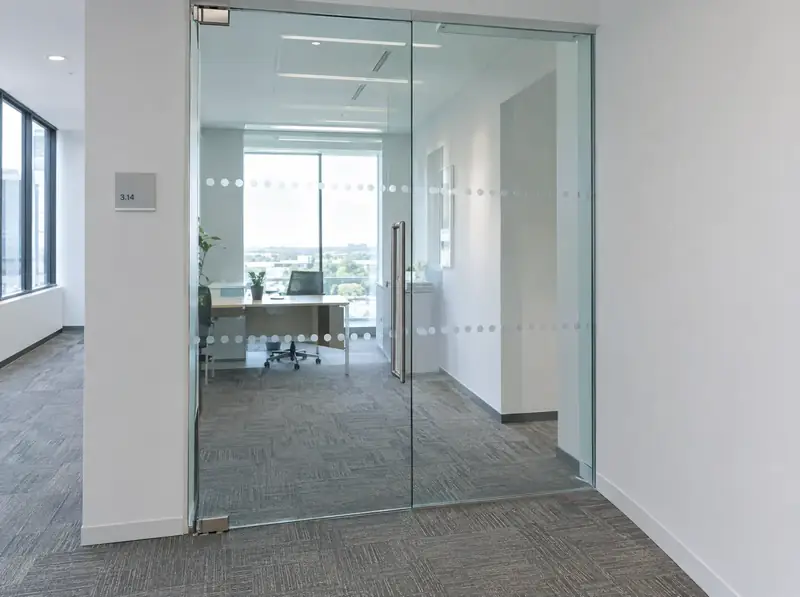
Glass manifestation is marking such as dots, bands, logos or frosted strips applied to glass doors, screens and partitions so people can see the glass and don't walk into it.
Clear glass is easy to miss when you're carrying something, looking at a phone or walking from a dim corridor into a bright room. Manifestation is the marking that stops people walking into it. Building guidance and workplace law both expect glazing that people could walk into to be marked where needed for safety, and landlords and inspectors may ask to see it.
It doesn't have to look like an afterthought. Manifestation can be a line of frosted dots, a band with your name cut through it, a repeated logo or a pattern that suits the interior. We measure the glazing, set markings at the recommended heights, check contrast against what lies behind the glass, and can fit early or late to keep disruption down.
At what height should manifestation go?
England's Approved Document K suggests marking glazing in two zones: one between 850 mm and 1000 mm above floor level, and another between 1400 mm and 1600 mm. Using two heights helps people of every height notice the marking, from young children and wheelchair users to standing adults.
Markings work when they run across the width of glass people could walk into, rather than as a single sticker in the middle of a wide pane. Heights are measured from the finished floor on site, allowing for ramps and changes in level.
Wales, Scotland and Northern Ireland have their own building guidance with the same aim, so the layout is checked against the guidance where your building is, before anything is fitted.
Is glass manifestation a legal requirement?
In workplaces it often is. Regulation 14 of the Workplace (Health, Safety and Welfare) Regulations 1992 requires transparent surfaces, such as glass doors and partitions, to be marked where necessary for safety; Northern Ireland has equivalent regulations from 1993. The duty usually sits with the employer or whoever controls the premises.
Approved Document K is guidance on meeting the Building Regulations in England, relevant when building work is carried out, such as new glazing or some fit-outs. Building control may expect manifestation in place before signing the work off.
Whether a building meets its duties is for the person in control of it to judge, not us. We set markings at the recommended heights and can provide a marked-up layout for your records, landlord or inspector.
What makes manifestation easy to see?
Contrast. A marking that blends into its background fails at its one job: white frosted dots read well against a dark corridor but can vanish against a bright window, while a dark grey band can disappear against dark furniture or a night-time view.
Check the glass from both sides and in different light: morning sun, evening lighting, and with blinds open or closed. The aim is a marking people notice without looking for it.
- Frosted dots and bands: discreet, but weakest against bright backgrounds
- Solid white, grey or brand colour: stronger where the background is pale or busy
- Two-tone designs: a light and a dark element, visible against almost anything
- Logos and lettering: repeated in both zones, with enough solid area to catch the eye
Do doors need different marking from side panels?
Both need marking, and the door should stand out from the panels beside it. In a frameless screen the two can look identical, which is how people walk into a panel while looking for the way through. A different pattern on the door, a push or pull sign, and contrasting handles or push plates all help.
Swinging glass doors need thought too: a door left open into a corridor is easy to walk into edge-on, where face markings can't be seen. Automatic sliding doors should be marked so people can tell when they're closed.
Keep door markings clear of the handle area, where hands wear them, and show every door and panel on the layout drawing so nothing is missed.
When do landlords and inspectors ask for it?
Usually at one of three moments: during a fit-out, when building control or the landlord's surveyor checks the work; after a health and safety inspection flags unmarked glass; or when a new occupier moves into space where the glazing was never marked, or old branding that doubled as marking has been stripped off.
Landlords often set rules in a fit-out guide or the lease: a standard pattern across the building, a colour for anything facing the street, or approval of branded designs. Check before designing, and note whether markings must come off when the lease ends.
If an inspector has asked for manifestation by a set date, mention it when you first get in touch so the survey can be planned around it.
Options and finishes
Frosted dots
Etch-effect dots in both zones.
Bands
Continuous frosted or coloured strips.
Logo manifestation
Your logo repeated along both zones.
Two-tone markings
Light and dark layers for any background.
Patterned designs
Geometric or brand-led patterns within the zones.
How much does glass manifestation cost?
Manifestation has a guide price of £65–£180 per door or pane, supplied and fitted, excluding VAT. A typical office floor of 6–12 panes is guided at £450–£1,450 + VAT, with a £195 + VAT minimum job.
Dots and bands cost least; logos and two-tone designs more. Pane size, old markings to remove and high glazing also count; the price is confirmed after survey.
| Item | Guide, ex VAT | Inc. VAT (20%) |
|---|---|---|
| Manifestation per door or pane | £65 – £180 | £78 – £216 |
| Typical office floor (6–12 panes) | £450 – £1,450 | £540 – £1,740 |
| Minimum job | £195 | £234 |
Guide prices exclude VAT and are confirmed after survey or artwork check. Basis: dots, bands or logo manifestation at the two standard heights, per door or pane. Minimum job £195 + VAT.
Permission and rules
Manifestation is a safety marking, so the rules that matter are building and workplace ones rather than advertisement consent. In England, Approved Document K suggests the two marking zones; Wales, Scotland and Northern Ireland have their own building guidance with the same aim. The Workplace (Health, Safety and Welfare) Regulations 1992 apply in Great Britain, with equivalent 1993 regulations in Northern Ireland. A branded design facing the street can count as a window graphic, which councils treat differently, so we check that case first. Many landlords also expect to approve designs.
Specification at a glance
| Typical size | Two zones: 850–1000 mm and 1400–1600 mm above floor |
|---|---|
| Materials | Frosted film, coloured cut vinyl or printed film |
| Typical lifespan | Typically many years indoors by manufacturer ratings |
| Typical lead time | typically fitted 1–2 weeks after layout approval |
| Fixing / installation | Levelled from the finished floor, room side of glass |
| Consent | Safety marking; landlords often approve branded designs |
Before you ask for a quote
- Count glass doors, side panels and screens per floor.
- Measure each pane's width; note frames and handles.
- Photograph each run of glass from both sides.
- Check the lease or fit-out guide for rules.
- Choose dots, bands, a logo or a pattern.