
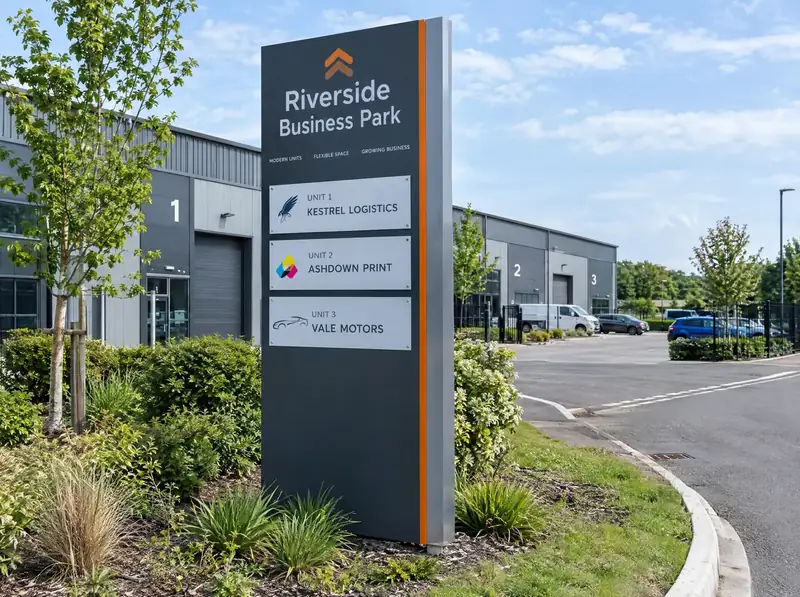
A totem sign is a free-standing sign on its own foundation, typically 1.5–4 m tall, used at site entrances and car parks to show a business name, tenants or directions where a wall sign won't be seen.
When a building sits back from the road, behind a car park or inside an estate, the wall sign can be invisible to the people you need to reach. A totem stands at the entrance, at driver eye level or above, and tells visitors they have arrived before they commit to the turn. On multi-tenant sites, one well-planned totem replaces a cluster of ad-hoc boards.
A totem is also a small structure, not just a sign. It needs a foundation designed for the ground and the wind, a clear route past buried cables and pipes, and a position that keeps drivers' sightlines open. We arrange the design, structural calculations, ground checks, consent drawings and installation as one job, and the sections below explain each step in turn.
What is the difference between a totem, a pylon and a monolith?
The names overlap. A totem is usually a slim, upright sign around head height or a little taller; a pylon is taller, often on one or two posts or a structural spine, and built to be read from a road; a monolith is a solid, block-like form with a broad face, used at prestige entrances.
All three are made the same way: an aluminium or steel internal frame clad in folded aluminium panels, powder coated, with graphics applied, routed or fabricated. The choice comes down to height, proportion and how far away the sign must be read. A tall, slim sign can look spindly, so proportions are drawn to scale.
- Totem: compact, for entrances and forecourts
- Pylon: taller, readable from the road
- Monolith: solid form for premium entrances
How do multi-tenant totems with swappable panels work?
Business parks, retail parks and shared office sites use a totem with a header for the site name and a stack of tenant panels below. Each tenant panel is a separate insert that slides into channels or fixes with hidden screws, so when a unit changes hands only that panel is replaced.
Size the panels around the longest likely tenant name, keep one font and layout throughout, and order a few blanks for future lettings. Lit totems use the same idea with interchangeable printed or routed faces. Unit numbers help delivery drivers and visitors as much as the names do.
- Header panel: site or park name
- Tenant inserts: slide-in or screw-fixed
- Unit numbers: help drivers and couriers
- Blank spares: ready for new lettings
What foundations and ground checks does a totem need?
Every totem stands on a concrete foundation sized for its height, face area and the ground it sits in. Structural calculations, using wind loading for the site's exposure, set the foundation size and the fixing detail; a tall sign in an open, exposed position needs far more than a small one on a sheltered forecourt.
Before digging, the area is scanned with a cable avoidance tool (CAT) and utility records are checked, because car parks and verges often hide cables, ducts and drainage. Soft, made-up or waterlogged ground can change the foundation design, and a trial hole may be dug first where the ground is uncertain.
- Utility records and CAT scan before excavation
- Foundation sized from structural calculations
- Base plate or cast-in frame, levelled and grouted
Where should a totem go so it doesn't block drivers' views?
Place it where drivers can read it in time to turn, but never in the visibility splay at a junction or site entrance. The splay is the triangle of clear view drivers need to see oncoming traffic and pedestrians, and signs, walls or planting inside it can obstruct sightlines.
Set the totem back from the footway, check it won't block a pedestrian route or parking bay, and leave room for maintenance access. Near a public road, the highway authority may have its own requirements. We plot the position on a site plan with sightlines marked before consent drawings are prepared.
- Readable on approach, before the turn
- Outside the visibility splay
- Clear of footways, bays and drainage
- Clear of overhead cables and tree canopies
Can a totem sign be illuminated?
Yes. Options include internally lit panels with routed letters backed in opal acrylic, push-through letters, face-lit built-up letters, or external floodlighting. LED modules and drivers sit inside the frame, the supply runs in a buried duct to the base, and an electrician makes the final connection to BS 7671, giving you the certificate for the circuit.
A time switch or photocell keeps the sign lit only when needed. Brightness should suit the surroundings, and councils commonly refer to the Institution of Lighting Professionals' guidance PLG05. Use static light only, with no flashing, unless consented. The distance to the nearest power supply affects the cost of the duct run.
- Routed or push-through letters, lit from inside
- Face-lit letters or external floodlights
- Time switch or photocell control
Options and finishes
Non-lit totem, 1.5–2 m
A compact entrance or forecourt sign in powder-coated aluminium.
Non-lit pylon, 2.5–4 m
A taller structure readable from a road, on a larger foundation.
Multi-tenant totem
A header panel plus slide-in tenant inserts changed as units are let.
Illuminated totem
Internally lit panels or routed and push-through letters with LED modules.
Monolith
A solid, block-like form with built-up letters for prestige entrances.
Directional totem
Smaller site signs pointing visitors to receptions, bays and buildings.
How much do totem and pylon signs cost?
Guide prices, supplied and installed with foundations and excluding VAT, are £1,950 to £3,950 for a non-lit totem 1.5–2 m tall and £3,950 to £7,500 for a non-lit totem 2.5–4 m tall. An illuminated totem with lit panels or letters is guided at £4,950 to £9,800.
Height and face area drive the structure, foundation and wind-loading design, so they move the price most. Lighting, tenant panels, built-up letters, surfacing to break out and reinstate, ground conditions and consent drawings follow. Every figure is confirmed after a site survey and services check.
| Item | Guide, ex VAT | Inc. VAT (20%) |
|---|---|---|
| Totem 1.5–2 m, non-lit | £1,950 – £3,950 | £2,340 – £4,740 |
| Totem 2.5–4 m, non-lit | £3,950 – £7,500 | £4,740 – £9,000 |
| Illuminated totem (lit panels or letters) | £4,950 – £9,800 | £5,940 – £11,760 |
Guide prices exclude VAT and are confirmed after survey or artwork check. Basis: free-standing aluminium totem 1.5–4 m tall, including foundations; illuminated versions quoted separately.
Permission and rules
A free-standing totem usually needs express advertisement consent from the council's planning department, especially if it is illuminated, tall or close to a road. In England, decisions usually take up to 8 weeks and consent is normally granted for 5 years. Illuminated totems cannot rely on deemed consent in conservation areas, National Parks, National Landscapes, the Broads or areas of special control. Councils also look at highway safety, so a site plan showing sightlines helps. Wales, Scotland and Northern Ireland have their own advertisement regulations and application routes. We can prepare the drawings, site plan and photos for an application, or submit it for you.
Specification at a glance
| Typical size | 1.5–4 m tall; width set by tenant panels and viewing distance |
|---|---|
| Materials | Aluminium or steel frame, folded powder-coated aluminium cladding, applied or routed graphics |
| Typical lifespan | Many years for the structure; tenant inserts and graphics replaced as needed |
| Typical lead time | typically 4–8 weeks after proof approval, plus any consent period |
| Fixing / installation | Concrete foundation from structural calculations, CAT-scanned excavation, base plate or cast-in frame |
| Consent | Usually needs express consent, especially when lit; decisions usually take up to 8 weeks |
Before you ask for a quote
- Mark the proposed position on a site plan or aerial photo.
- Photograph the entrance from the road, as drivers approach from each direction.
- List the names or tenants to display, with logos and brand colours.
- Note the ground surface: tarmac, block paving, grass or soil.
- Decide whether the totem should be lit, and whether power is nearby.