
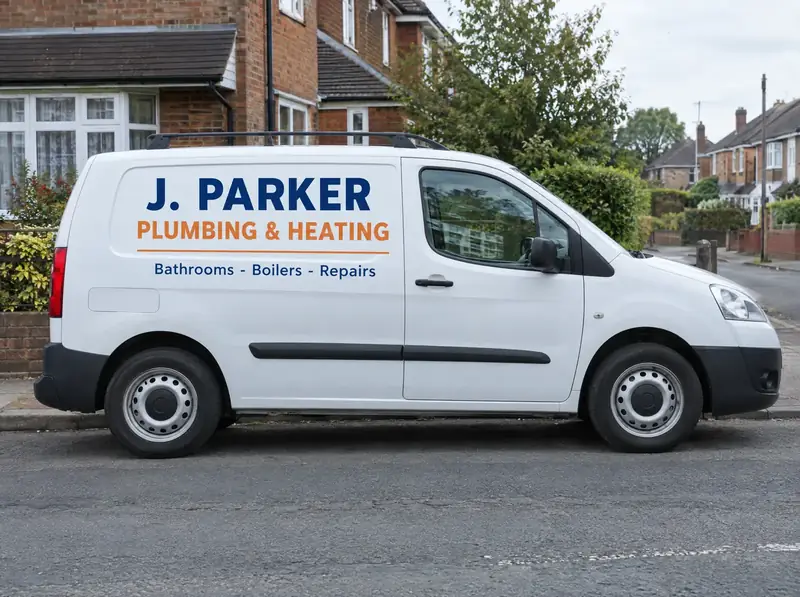
Van sign-writing is lettering, a logo and contact details cut from coloured vinyl and applied straight onto a van's paint, usually on the sides and rear doors, without covering whole panels in printed film.
For most sole traders and small firms, lettering does the main job of a wrap for a fraction of the cost. Your business name, what you do and a phone number, cut from solid-colour vinyl, sit on the factory paint and can be read from across the road. Printed logo panels can be added where a logo has gradients, photos or several colours.
There's far less film to fit, so sign-writing is typically applied in 2–4 hours, and it can often be done at your home or yard when the weather is dry and mild. When your number, services or web address change, single lines can be peeled off and replaced. That makes lettering a practical start for a new business, with room to move up to a wrap later.
What should a sign-written van say?
Say who you are, what you do and how to contact you, in that order of size. Most people see a van for a few seconds, so three or four pieces of information are plenty. Anything more turns into small print nobody reads.
Lead with the business name, then a short line of services in plain words: 'Plumbing · Heating · Boiler repairs' works better than a long list. The phone number should be the second-largest thing on the van. A web address and one or two social handles can sit smaller underneath, mainly for people parked beside you.
- Business name, largest
- Two to four services in plain words
- One phone number, mobile or landline
- Website and social handles, smaller
How big and bold should van lettering be?
Lettering needs to be readable at a distance and at speed, so size and contrast matter more than style. Simple, solid fonts read fastest; thin scripts, outlines and tightly spaced capitals blur together from a few car lengths away.
On the sides, give the business name and phone number as much height as the panel allows between the swage lines and wheel arches. Pick colours with strong contrast against the paint, such as navy or black on a white van and white or yellow on a dark one, and keep text off ribbed sections and door handles.
- Check the proof at arm's length on your phone screen
- Use no more than two fonts
- Leave clear space around the phone number so it stands alone
What goes on the rear doors?
The rear doors are read more than any other part of the van, because drivers sit behind them at lights and in queues. Give them the business name, the phone number in large figures and, if room allows, the web address.
Keep lettering clear of handles, hinges, rear lights, the number plate and the lamp above it. On glazed rear doors, lettering usually goes below the windows; perforated one-way vision film can carry graphics on the rear glass of vans with two exterior mirrors. If the van also needs Chapter 8 chevrons for roadside work, the lettering is planned around them.
- Split names across the door gap with care, or keep them to one door
- Repeat the phone number here even if it's on the sides
- Keep the web address short enough to remember
Is reflective lettering worth adding?
Reflective vinyl returns headlight beams towards the driver, so lettering that looks ordinary by day shows up brightly at night. It's most useful on the rear doors and for the phone number, and on vans parked on unlit streets or driven early and late in winter.
It costs more than standard vinyl and comes in a narrower range of colours, so most firms use it for one or two elements rather than everything. Reflective lettering is not a substitute for Chapter 8 chevrons if your van stops on the highway to work; those follow their own pattern and are fitted as a separate kit.
- Reflective phone number on the rear doors
- Reflective outline around the business name
- Reflective strip along the lower sides
How easy is it to change or remove lettering later?
Changing one line is simple: the old vinyl is warmed, peeled off and the area cleaned, then the new line is fitted to the same layout. That suits growing businesses that add services, change numbers or move to a new web address.
On older vans, the paint around lettering fades in the sun while the paint underneath doesn't, which can leave a faint outline called ghosting when lettering comes off. It varies with the paint colour and how long the lettering has been on. New lettering placed over the same spot can hide it, so we plan updates around the old layout where we can.
- Keep your proof file so lettering can be matched later
- Replace a whole line rather than single characters
- Tell us the van's age so we can judge the ghosting risk
Options and finishes
Lettering only
Name, services and contact details cut in one or two vinyl colours.
Lettering with printed logo panels
Cut lettering plus a printed, laminated logo where colours or gradients need it.
Reflective lettering
Retroreflective vinyl for key details, bright in headlights at night.
Metallic or outlined lettering
Metallic-effect vinyl or a contrasting outline to lift text on darker paint.
Rear-window graphics
Perforated one-way vision film on the rear glass of vans with two exterior mirrors.
How much does van sign-writing cost?
Guide prices for van sign-writing start from £245 + VAT for basic lettering on the sides and rear, typically up to £450 + VAT. Lettering with printed logo panels is typically between £395 and £895 + VAT.
What moves the price: the size of the van, how many words and lines you want, the number of vinyl colours, printed logo panels, reflective or metallic film, and whether old lettering has to come off first. Every figure is a guide excluding VAT, confirmed once we've seen your wording and photos of the van.
| Item | Guide, ex VAT | Inc. VAT (20%) |
|---|---|---|
| Basic lettering (sides and rear) | £245 – £450 | £294 – £540 |
| Lettering with printed logo panels | £395 – £895 | £474 – £1,074 |
Guide prices exclude VAT and are confirmed after survey or artwork check. Basis: cut vinyl lettering, logo and contact details on sides and rear.
Permission and rules
Council consent rarely comes into van lettering. Advertisement control doesn't usually reach a vehicle normally used as a moving vehicle, which is what a working van is. It can apply to a van parked up mainly as a static advert, and England, Wales, Scotland and Northern Ireland each have their own regulations, so ask the council before trying that. Lettering leaves the van's main colour unchanged, so there's nothing to update on the log book. A lease agreement may set rules on graphics and how they come off at the end, so read it first. Keep lettering off the windscreen and front side windows, which have legal minimums for how much light they let through.
Specification at a glance
| Typical size | Small car-derived vans to long-wheelbase vans; sides and rear doors |
|---|---|
| Materials | Cut cast or polymeric vinyl; printed, laminated logo panels where needed |
| Typical lifespan | Cast vinyl commonly manufacturer-rated around 5–7 years; polymeric vinyl rated shorter |
| Typical lead time | typically 3–7 working days from approved proof; fitting typically 2–4 hours |
| Fixing / installation | Applied to clean, dry paint, often at your home or yard in mild weather |
| Consent | Not usually needed for a working van; V5C unaffected |
Before you ask for a quote
- Exact wording: business name, up to four services, phone number, website and social handles
- Your van's make, model and year, plus photos of both sides and the rear doors
- Logo files, vector if you have them, and the colours you use
- The van's paint colour, so we can pick lettering with strong contrast
- Any old lettering that needs removing first