
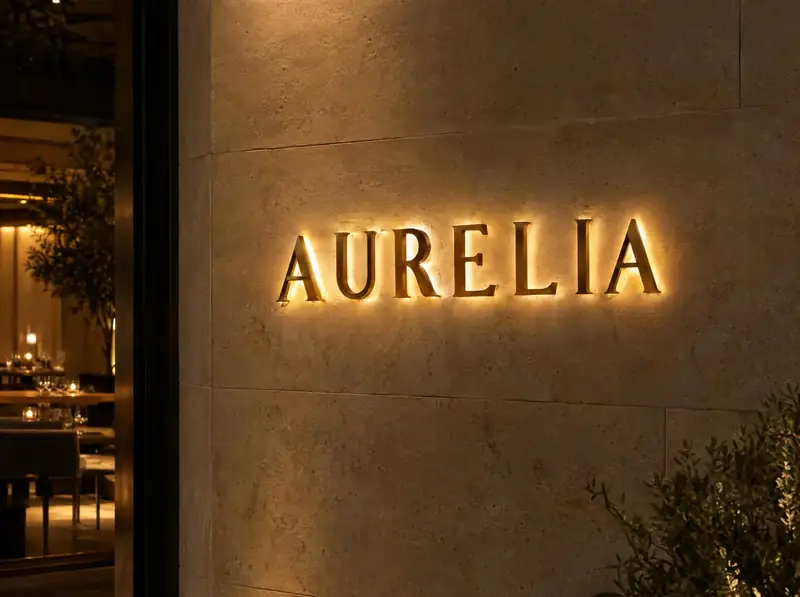
Halo-lit letters are solid-faced fabricated letters with LEDs inside that shine backwards onto the wall, so each letter stands in silhouette against a soft outline of light.
Halo lighting is the quiet way to light a name. The letter face stays solid metal, the back is open, and LEDs inside push light onto the wall. By day you see crisp brushed steel or brass; after dark each letter stands in silhouette against its own glow. That restraint is why hotels, restaurants, law firms and head offices so often choose it.
Halo letters are less forgiving than face-lit ones, though. The wall finish, the stand-off distance and the colour of light all change the result, because the stone, render or panel behind the letters becomes part of the sign. This guide covers those choices, the metal finishes, combined face-and-halo letters and the advertisement consent you're likely to need before anything is fitted.
How does halo lighting work?
A halo letter is built the opposite way to a face-lit one. The face and returns are solid metal, the back is open or closed with clear polycarbonate, and the LEDs point towards the wall. Locators hold each letter 25–50 mm off the surface, so light spills out around the edges.
Returns of 50–100 mm are typical, deep enough to hide the LEDs from normal viewing angles. The modules sit near the open back, facing the wall, and a clear back panel keeps out rain, dirt and insects while still letting the light through.
- Solid face: no light passes through the front
- Stand-off: 25–50 mm sets the width of the glow
- Stroke width: very thin strokes give a faint halo
Which metal finishes are available?
Brushed stainless steel is the workhorse: grade 304 suits most locations and 316 is used near the coast, where salt air marks lower grades. Mirror-polished stainless is dramatic but shows smears and scratches, so it suits sheltered spots. Brass and bronze finishes give a warm hospitality feel, and powder-coated letters can be any RAL colour, including a matt black that reads strongly in silhouette against a lit wall.
Match the halo colour to the metal. Warm white sits naturally with brass, bronze and copper; neutral or cool white suits stainless and painted letters. Ask whether you're getting solid metal or a coated finish on a steel or aluminium base, because the two look alike when new but age differently outdoors.
Does the wall behind matter?
More than with any other lit sign, because the wall is what you actually see glowing. Pale, smooth, matt surfaces give the cleanest halo. Dark brick or cladding absorbs most of the light, glossy tiles or polished stone can reflect individual LEDs as dots, and deep texture breaks the outline into patches.
If the wall isn't right, the letters can be mounted on a backing panel: a pale painted aluminium or aluminium composite sheet that gives the halo a consistent surface. The survey records the wall finish, and a night-time visual shows what to expect.
- Pale stone, smooth render, painted panels: a clean halo
- Dark brick or cladding: add a backing panel
- Gloss tiles, polished stone: risk of LED reflections
When do face-and-halo letters make sense?
Combined letters have an opal acrylic face lit from inside and an open back that lights the wall, so the name glows head-on and is framed by a halo. They read from noticeably further away than pure halo letters, which helps on main roads, retail parks and taller buildings. Where people see the sign from a moving car, the extra reach usually justifies the extra cost.
The trade-offs are cost and complexity. Each letter needs LEDs lighting both ways and more driver capacity, and the look is busier, so on a quiet street or a heritage building pure halo usually sits more comfortably. Face and halo colours can differ, such as a crisp white face over a warm amber halo.
What does fitting halo letters involve?
A full-size template is fixed to the wall to mark the position of each locator and cable hole. Holes are drilled, locators are bonded or screwed in, and each letter is offered up, connected and set to the right stand-off. Drivers go somewhere dry, ventilated and reachable, with cables passing through the wall behind the letters so nothing shows.
On stone and historic buildings, fixings into mortar joints rather than the stone face are usually preferred, and resin anchors spread the load in softer materials. Fitters work from a tower, scaffold or access platform as the height requires, under the Work at Height Regulations 2005. An electrician makes the final mains connection to BS 7671 and you receive the certificate for the circuit.
Options and finishes
Brushed stainless
Grade 304, or 316 near the coast; cool and hard-wearing.
Brass or bronze
Warm faces for hospitality, lacquered to slow tarnishing.
Painted or powder-coated
Any RAL colour; matt black gives the boldest silhouette.
Face-and-halo
An opal face plus a lit wall, for longer viewing distances.
Backing panel
A pale panel behind the letters for dark or rough walls.
How much do halo-lit letters cost?
Guide price: £160–£420 + VAT per halo-lit letter 300–600 mm tall, or £2,800–£9,800 + VAT for a typical 10–14 letter name, plus a guide £150–£350 + VAT for the electrician's final connection. Prices exclude VAT and are confirmed after survey and artwork check.
Metal and finish matter most: brass, bronze and mirror cost more than painted or brushed. Face-and-halo letters, backing panels, stone drilling and access equipment add to the total.
| Item | Guide, ex VAT | Inc. VAT (20%) |
|---|---|---|
| Halo-lit letter, 300–600 mm | £160 – £420 | £192 – £504 |
| Typical business name (10–14 letters) | £2,800 – £9,800 | £3,360 – £11,760 |
| Final electrical connection by an electrician | £150 – £350 | £180 – £420 |
Guide prices exclude VAT and are confirmed after survey or artwork check. Basis: reverse-lit metal letters 300–600 mm tall, stood off the wall, LED modules and drivers.
Permission and rules
Halo-lit letters count as illuminated advertisements, so in England they miss out on the wider deemed consent given to unlit signs. Most need express consent, and lit signs get no deemed consent in conservation areas, National Parks, National Landscapes, the Broads or areas of special control. Decisions usually take up to 8 weeks; consent is normally granted for 5 years. If the building is listed, listed building consent is usually needed too. Wales, Scotland and Northern Ireland have their own regulations. We can prepare the drawings and lit visuals for an application, or submit it for you.
Specification at a glance
| Typical size | Letters 300–600 mm tall, stood 25–50 mm off the wall |
|---|---|
| Materials | Stainless steel, brass or bronze finishes, painted aluminium; LEDs |
| Typical lifespan | Metal faces last for years; LEDs manufacturer-rated for long life |
| Typical lead time | typically 4–6 weeks after proof approval, plus consent |
| Fixing / installation | Locators into the wall; one cable hole per letter |
| Consent | Express consent usually; listed building consent if listed |
Before you ask for a quote
- Photograph the wall where the letters will go.
- Note the wall material and colour.
- Choose a metal finish and a warm or cool halo.
- Check whether the building is listed or in a conservation area.
- Ask where an electrician could take a supply.