
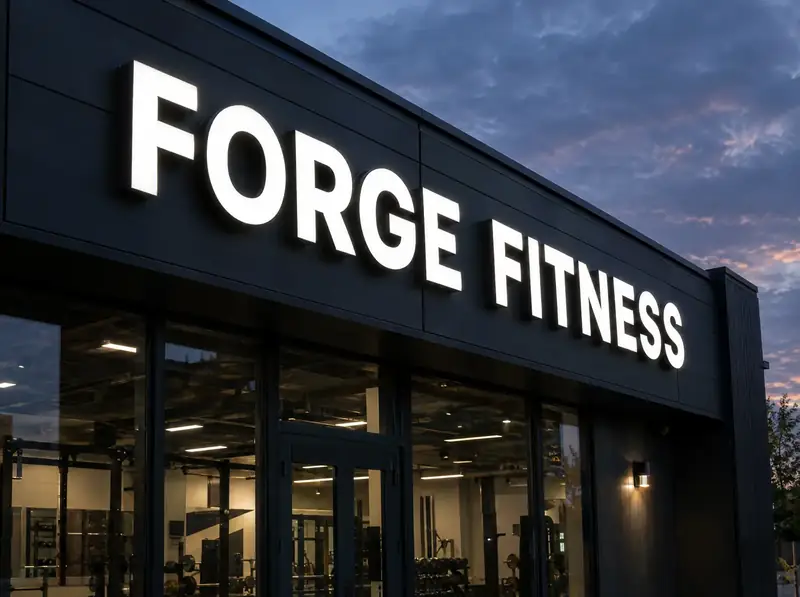
Illuminated built-up letters are fabricated 3D letters with translucent opal acrylic faces and LED modules inside, so each face glows and your name reads clearly after dark.
Putting your name in light usually starts with face-lit letters. Each character is a hollow shell: a translucent face, a side wall called the return, and LED modules fixed inside. After dark the faces glow; in daylight the letters still look like solid, sharply cut 3D lettering, so the sign works around the clock and reads clearly from right across the road.
The details decide how good they look and how long they last: face colour against the colour of light, letter depth, trim cap or trimless edges, and how the cables reach the hidden drivers. This guide covers each one, plus the electrician's sign-off and advertisement consent, because in England most lit fascia signs need express consent before they go up.
How are face-lit letters made?
Each letter is a shallow, sealed box. The back is aluminium or aluminium composite, the returns are folded aluminium, stainless steel or acrylic, and the face is opal acrylic that spreads the light evenly. LED modules fixed inside the back are wired to a low-voltage driver.
Where the face meets the return there are two common finishes. Trim cap is a narrow plastic edging that holds the face in place; it's robust and easy to open for repairs. Trimless letters hold the face inside a fine metal lip, giving a sharper edge at a higher price.
- Opal acrylic faces, white or coloured with translucent vinyl
- Returns typically 50–100 mm deep
- Acrylic returns if the sides should glow too
- Outdoor-rated LED modules and drivers
Will the colour look the same at night?
Not always, so it's worth deciding early. The daytime colour comes from the face: opal acrylic covered with translucent vinyl or made in a tinted sheet. At night that face mixes with the colour of the light behind it, and some brand shades, especially deep reds and greys, shift noticeably once lit.
White LEDs come in cool, neutral and warm tones, measured in kelvin; cool white keeps whites crisp, while warm white flatters reds and creams. Coloured LEDs behind a white face give a strong colour at night but a white letter by day. A day/night film looks black in daylight and glows white when lit, which suits black-on-white brands. If an exact shade matters, ask to see a lit sample before production.
How do you avoid hot spots?
Even illumination comes down to depth and LED layout. Light needs room to spread before it reaches the face, so deeper letters glow evenly with fewer modules, while shallow letters need modules packed closer together. Too few modules leave dim corners; too many close to the face show as bright dots.
Lettering style matters too. Thin strokes, fine serifs and joined script are hard to light evenly, so very delicate fonts may need slightly thicker strokes or a different lighting method. Letters are normally lit and tested in full before they're dispatched, so problems are caught early.
- Deeper returns for large letters and long viewing distances
- Module spacing matched to depth and stroke width
- Opal faces chosen for diffusion, not just colour
How does power reach the letters?
Each letter has a small cable exit in its back, lined up with a hole drilled through the fascia or wall. Low-voltage cables run behind the fascia to the drivers, which go somewhere dry, ventilated and reachable, such as the void behind the fascia or a ceiling space inside.
An electrician makes the final connection to the mains to BS 7671, the IET Wiring Regulations, and you receive the certificate for the circuit. Most owners also add a time switch or photocell, so the letters light only when people are around to see them.
- A clear cable route behind each letter
- A reachable spot for drivers, away from heat and water
- A switched supply provided by an electrician
- A time switch, photocell or both
Can letters fix straight to your building?
Usually, if the surface behind is sound. Any old sign comes down and the surface is made good beforehand. Letters are fixed with stainless steel studs into a solid fascia, aluminium composite panel, brick or cladding, using a full-size template to set the spacing. Soft or rotten timber fascias are normally overclad with a new panel, giving the fixings and cable holes something firm to grip.
Where you can't drill a hole behind every letter, the letters can sit on a raceway: a slim painted box that carries the drivers and cables and needs only one entry point into the building. Letters of 300–600 mm suit most single-storey shopfronts, and a scaled proof on a photo of your building settles the exact height.
Options and finishes
Trim cap
A plastic edge holds each face on; robust and easy to service.
Trimless
Faces sit inside a fine metal lip for a sharper edge.
Fully lit acrylic
Faces and returns both glow, so letters read well from an angle.
Day/night faces
Film that looks black by day and glows white once lit.
Raceway mounted
Letters on a slim box that hides the drivers.
How much do illuminated built-up letters cost?
Guide price: £140–£360 + VAT per face-lit letter 300–600 mm tall, or £2,400–£8,900 + VAT for a typical 10–14 letter name. The electrician's final connection is a guide £150–£350 + VAT. All prices exclude VAT and are confirmed after survey and artwork check.
Height and letter count drive most of the cost; stainless returns and trimless faces add more, as do access equipment, old-sign removal and consent drawings.
| Item | Guide, ex VAT | Inc. VAT (20%) |
|---|---|---|
| Face-lit letter, 300–600 mm | £140 – £360 | £168 – £432 |
| Typical business name (10–14 letters) | £2,400 – £8,900 | £2,880 – £10,680 |
| Final electrical connection by an electrician | £150 – £350 | £180 – £420 |
Guide prices exclude VAT and are confirmed after survey or artwork check. Basis: face-lit fabricated letters 300–600 mm tall with opal acrylic faces, LED modules and drivers.
Permission and rules
In England, lit signs get only limited deemed consent, and none in conservation areas, National Parks, National Landscapes, the Broads or areas of special control, so most face-lit fascia letters need express consent. Decisions usually take up to 8 weeks; consent is normally granted for 5 years. Brightness is often judged against the Institution of Lighting Professionals' PLG05 guidance, and lighting should be static. Listed buildings usually need listed building consent too. Wales, Scotland and Northern Ireland have their own regulations. We can prepare the drawings and photos for an application, or submit it for you.
Specification at a glance
| Typical size | Letters 300–600 mm tall; returns 50–100 mm deep |
|---|---|
| Materials | Opal acrylic faces, metal or acrylic returns, LED modules |
| Typical lifespan | LEDs commonly rated by manufacturers for about 50,000 hours |
| Typical lead time | typically 3–5 weeks after proof approval, plus consent |
| Fixing / installation | Stainless studs; cables through the fascia to drivers |
| Consent | Express advertisement consent usually needed |
Before you ask for a quote
- Measure the fascia's width, height and height above the pavement.
- Photograph the frontage straight on, plus fascia close-ups.
- Look for a void or ceiling space for the drivers.
- Send your logo as a vector file.
- Check whether the building is listed or in a conservation area.